
This post contains affiliate links. If you book through them, I may earn a small commission at no extra cost to you.
In Part 1, we watched kabuki inside Kengo Kuma’s Kabuki-za in Ginza. For Part 2, we leave Tokyo for a small town most visitors have never heard of: Sakai, in Ibaraki Prefecture. Kuma has designed seven or eight buildings here, and the main ones stand within a few minutes’ walk of each other. Few places in Japan let you see so many of his works in one stroll.
As a geography teacher, I was curious about one question: why would a world-famous architect keep coming back to a quiet farming town on the Tone River? The answer, as so often in Japan, starts with a river.
Quick facts
| What | Walk between Kengo Kuma buildings in a small river town, with a dried sweet potato café and a lunch stop |
| Where | Sakai, Ibaraki Prefecture, on the Tone River |
| Cost | Highway bus from Tokyo Station ¥1,800 one way. Town bus: free. Buildings: free to see from outside |
| Time | Half a day in town, plus about 1.5 hours each way from Tokyo |
| From Tokyo | Highway bus from Tokyo Station (Yaesu South Exit) to Sakai Highway Bus Terminal, then the free town bus |
Find your way
The buildings are in two groups, a short walk apart. Open these on your phone to find them:
- Group 1: HOSHIIMONO100 Café, S-Lab and S-Gallery, next to the Sakahana-cho bus stop
- Group 2: Sakai Sand and Chakura at Michi-no-Eki Sakai, the roadside station
- Bus: Sakai Highway Bus Terminal, where buses from Tokyo arrive
Why Kuma came to a small river town
Sakai grew up as a kashi, a river port. In the Edo period, rice, soy sauce and other goods from northern Japan came down the Tone River to Sakai. Just across the water, at Sekiyado, the Edo River branches off and flows south to Tokyo Bay. So from Sakai, boats could carry cargo all the way to the city of Edo, today’s Tokyo. Katsushika Hokusai, the artist of the famous Great Wave, made a print of this river in the early 1830s: “The Tone River in Sōshū,” from his series A Thousand Pictures of the Sea, with fishermen casting their nets from small boats.
If you rode the water bus down the Sumida River with us, you have already seen the other end of this old water network. You will still find the memory of the river port in Sakai today, in names like “Kashi-no-Eki” and “Sakai Kashi Restaurant.”
When trains and trucks replaced boats, the town lost its role and, like many places in rural Japan, its center began to empty out. The turning point was a mix of local food and modern design. The town built S-Lab, one of Kuma’s buildings, as a lab for developing local products. A dried sweet potato (hoshiimo) created there became a hit as a thank-you gift in Japan’s furusato nozei program, a system where people donate to a town of their choice and receive local products in return. According to Japan’s Ministry of Finance, donations to Sakai rose from just ¥65,000 in fiscal 2013 to ¥4.85 billion in fiscal 2021. Here, architecture became part of how the town earns its living.
Look closely and you will see that Kuma’s designs here borrow from local life: the bamboo blinds used to dry sweet potatoes, the fibers of the potato itself, the storehouses of the old river port. Most of them use wooden louvers, slats of timber set at angles, his signature.
HOSHIIMONO100 Café: a building inspired by dried sweet potatoes
Get off the town bus at Sakahana-cho and you will see it right away: a white building wrapped in slanted wooden louvers. They are said to echo the bamboo blinds used to dry sweet potatoes, and the fibers of the potato itself. As the sun moves, the louvers throw layers of light and shadow across the facade, so the building looks different every time you glance at it.
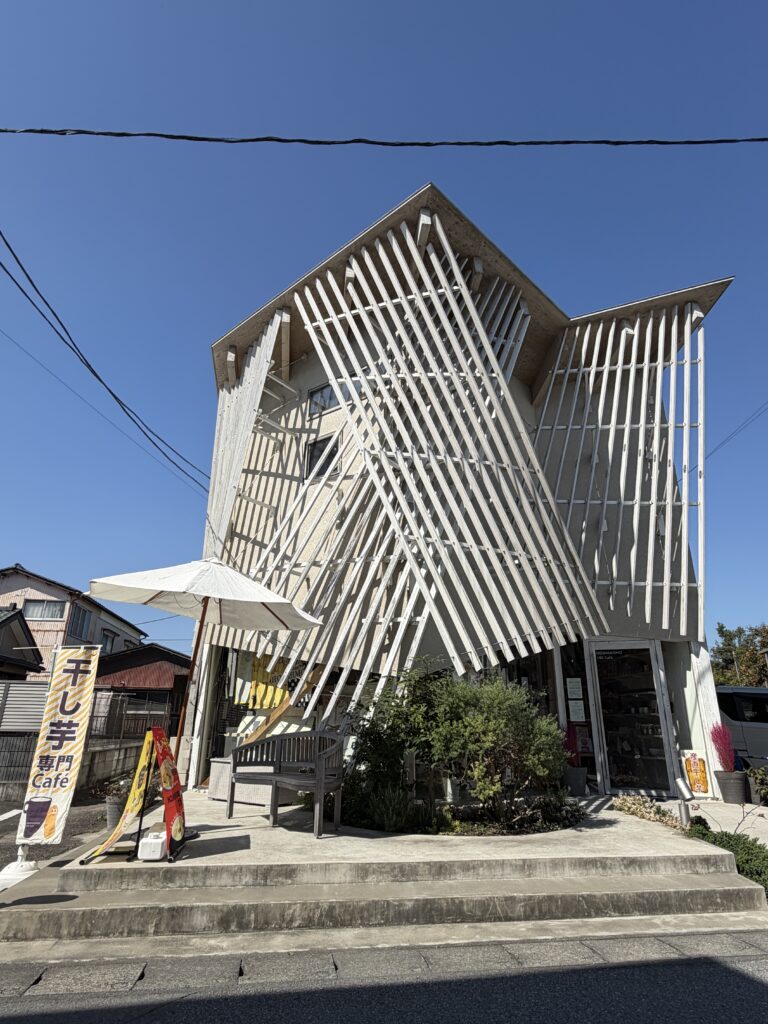
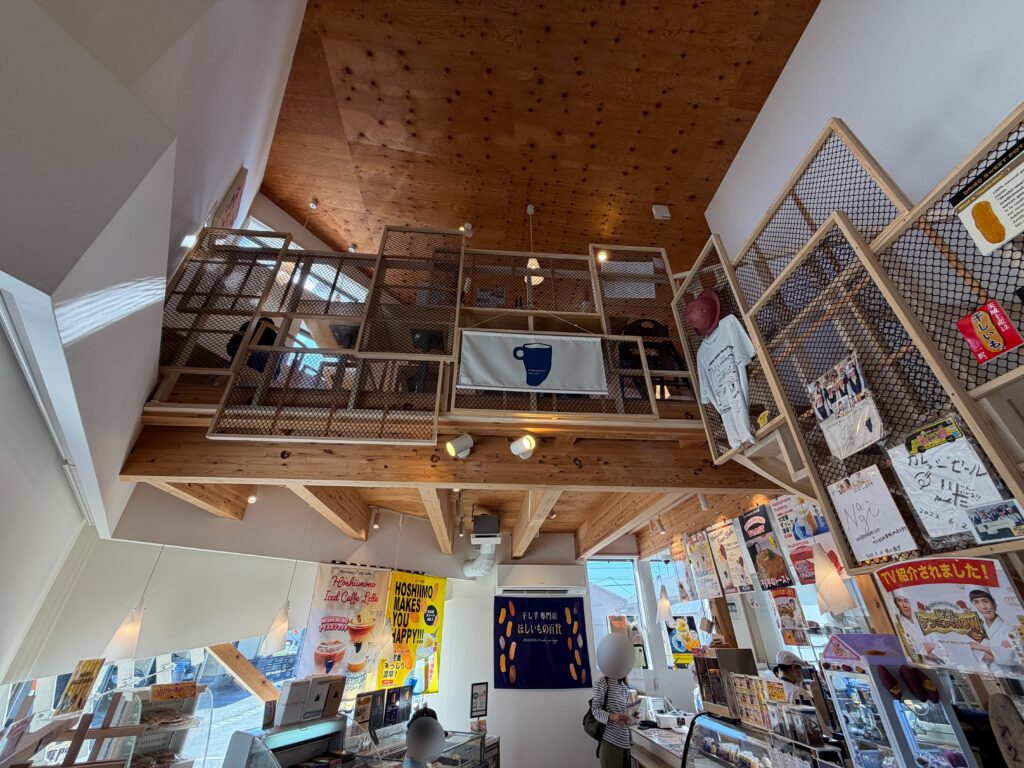
This is the main shop of Hoshiimono Hyakka, a dried sweet potato specialist, with a café inside. Try the hoshiimo pudding, a cake or a café latte. The sweetness comes gently from the potato itself. With all that warm wood around you, it is a genuinely calming place to sit for a while, and a good spot to buy snacks for the trip home.
S-Lab and S-Gallery: a lab you can look into
Right next to the café is S-Lab, the research and development center where local products are created. Its walls are mostly large sheets of glass, so you can watch steps such as dried sweet potato processing and winemaking from outside. Look up at the deep eaves: their wooden underside is the building’s best feature. S-Lab is joined in an L shape to S-Gallery, a small museum for the painter Shukusanpō, who spent his later years in Sakai.
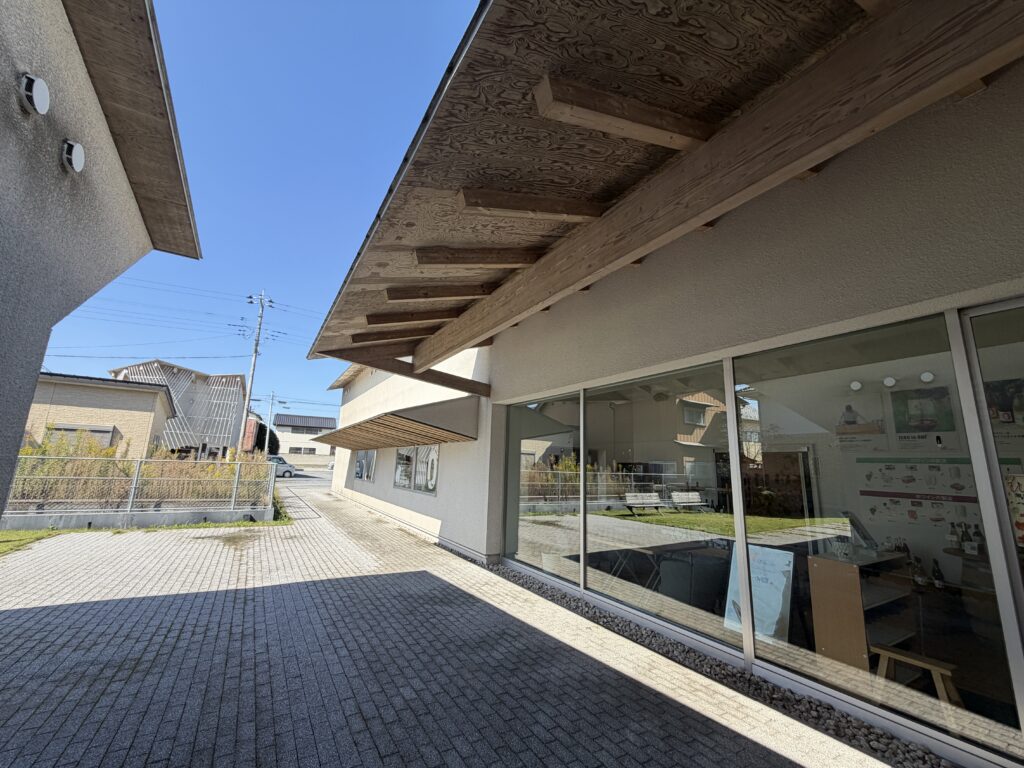
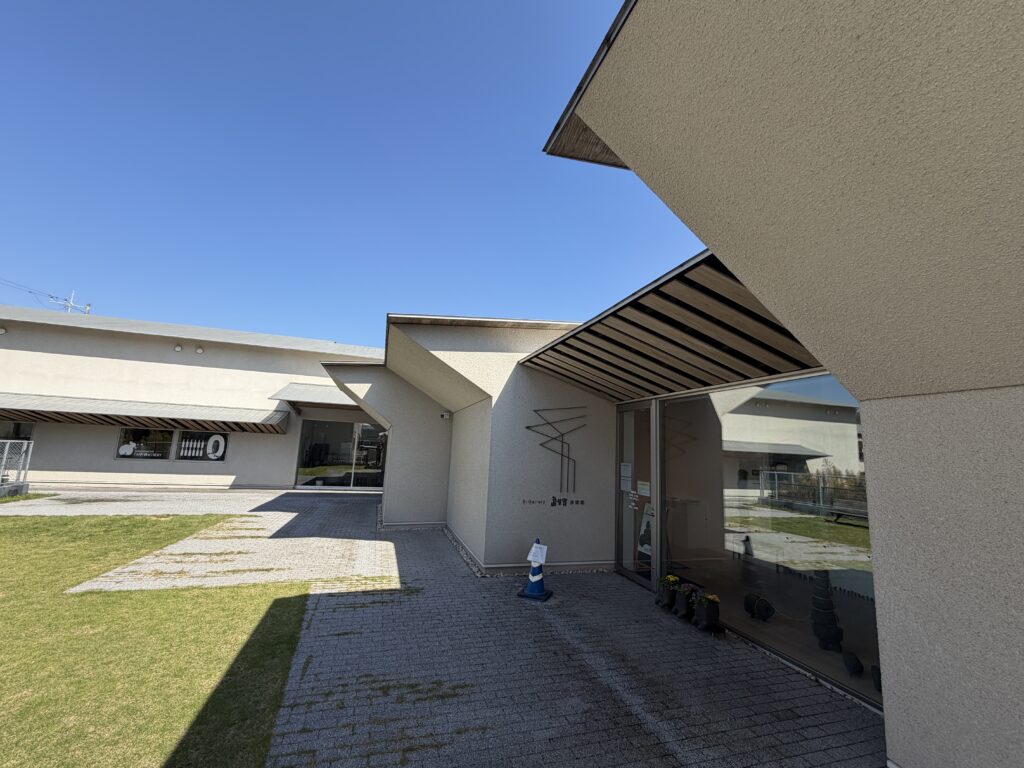
Both were closed on the Sunday I visited, so I could only enjoy them from outside. S-Gallery is officially closed on Mondays and Tuesdays, but it may also close on other days, so check before you go if you want to step inside.
Sakai Sand: where it all began
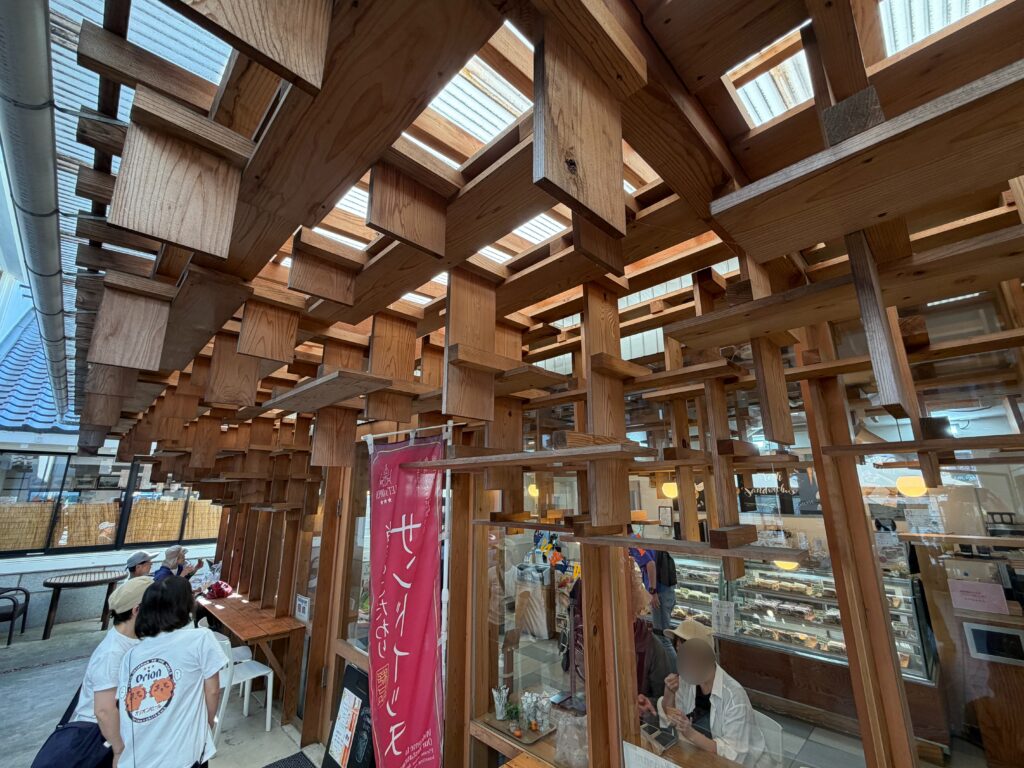
From the café, walk south to Michi-no-Eki Sakai, the town’s roadside station with a farmers’ market and souvenir shop. Inside is Sakai Sand, a sandwich shop that opened in 2018 as the very first project between Kuma and the town. The sandwiches are filled with fresh local vegetables and fruit. What I loved most was the structure: boards of timber stacked and crossed overhead in a bold, almost playful way.
Chakura: a storehouse with wings
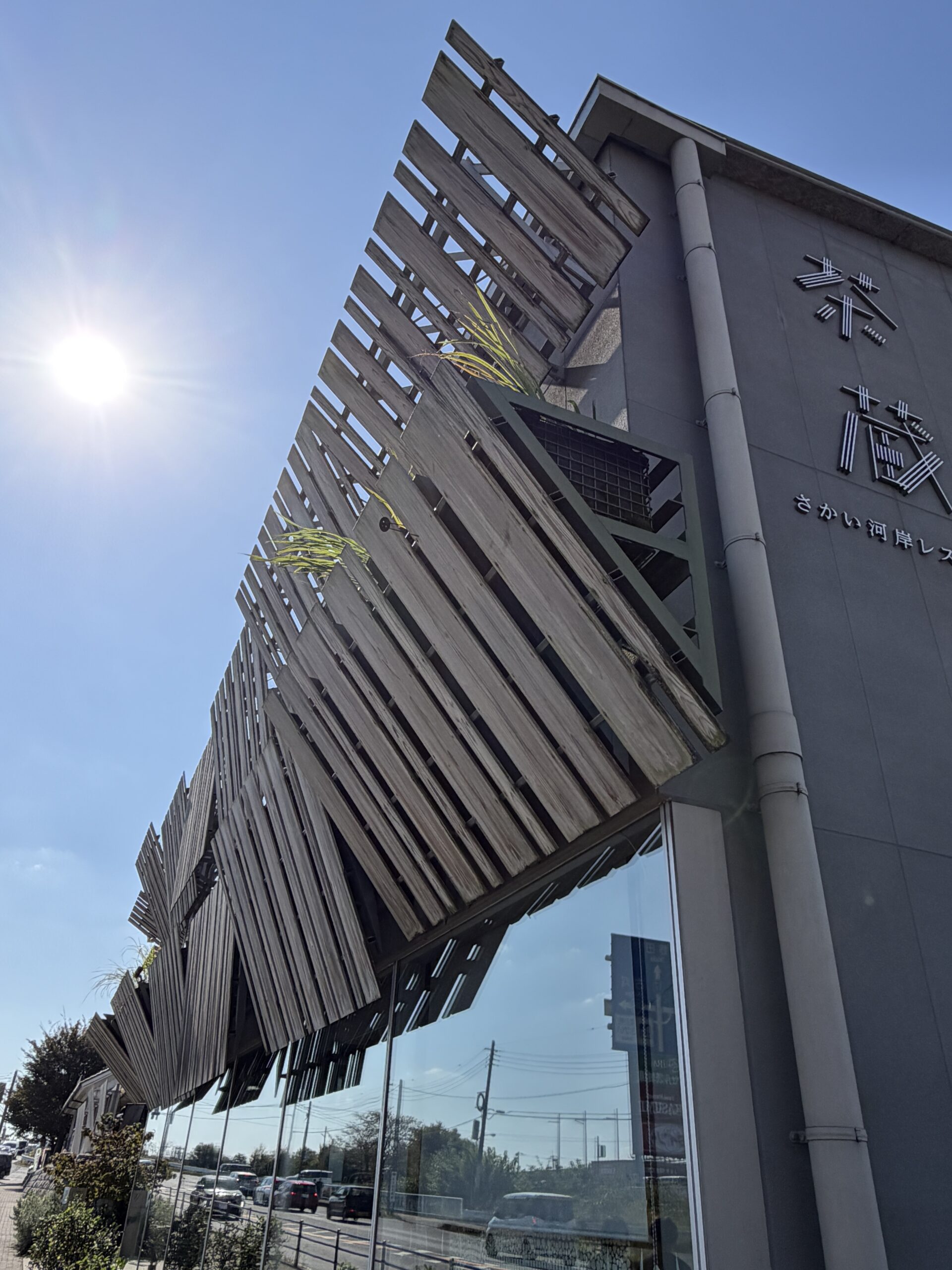
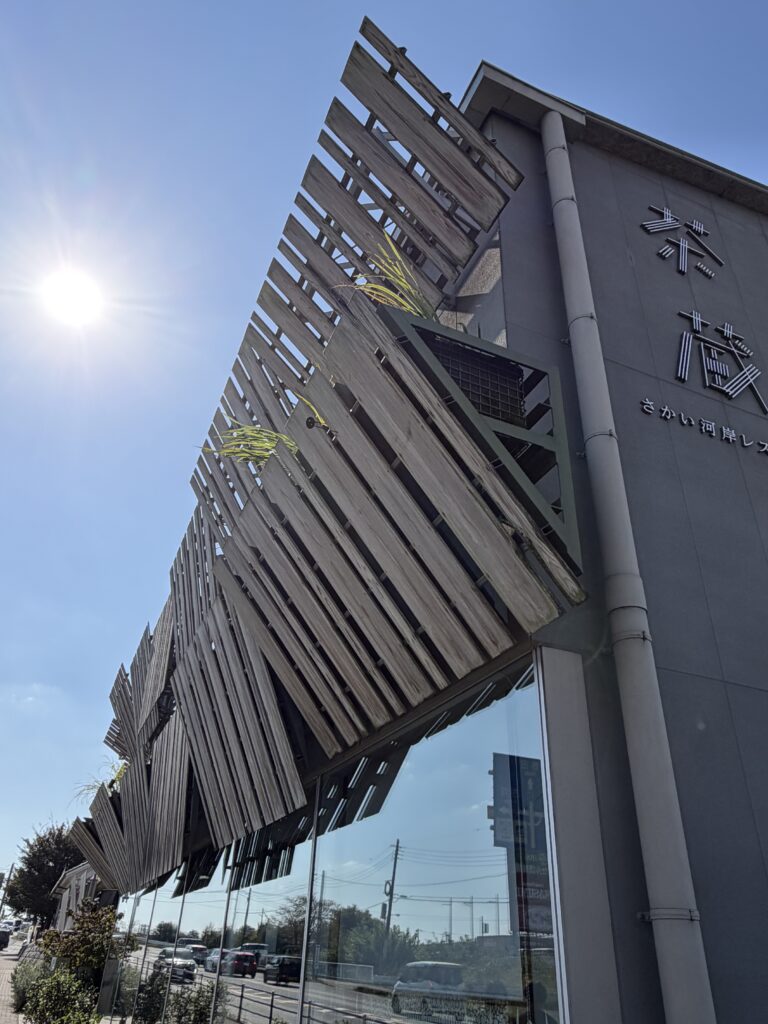
Next door stands Chakura, the “Sakai Kashi Restaurant.” Its tall gray wall recalls the kura storehouses of the old river port, and on it hang huge wooden louvers that spread out like wings. Seen from below, it is breathtaking, one of the boldest designs in the town.
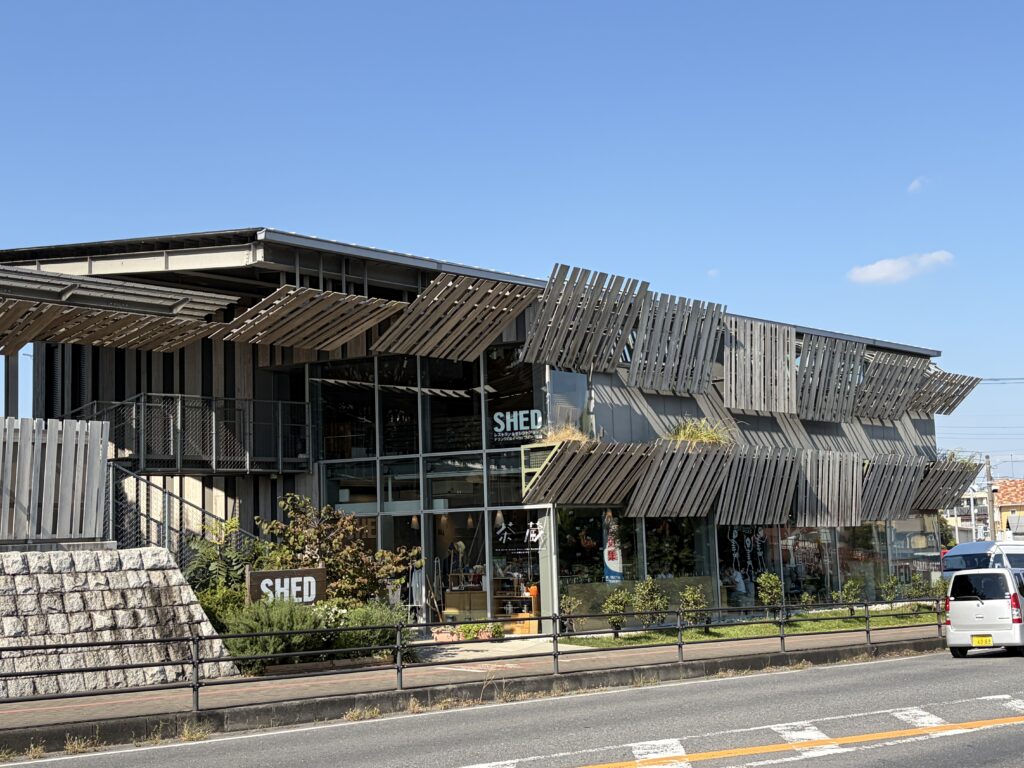
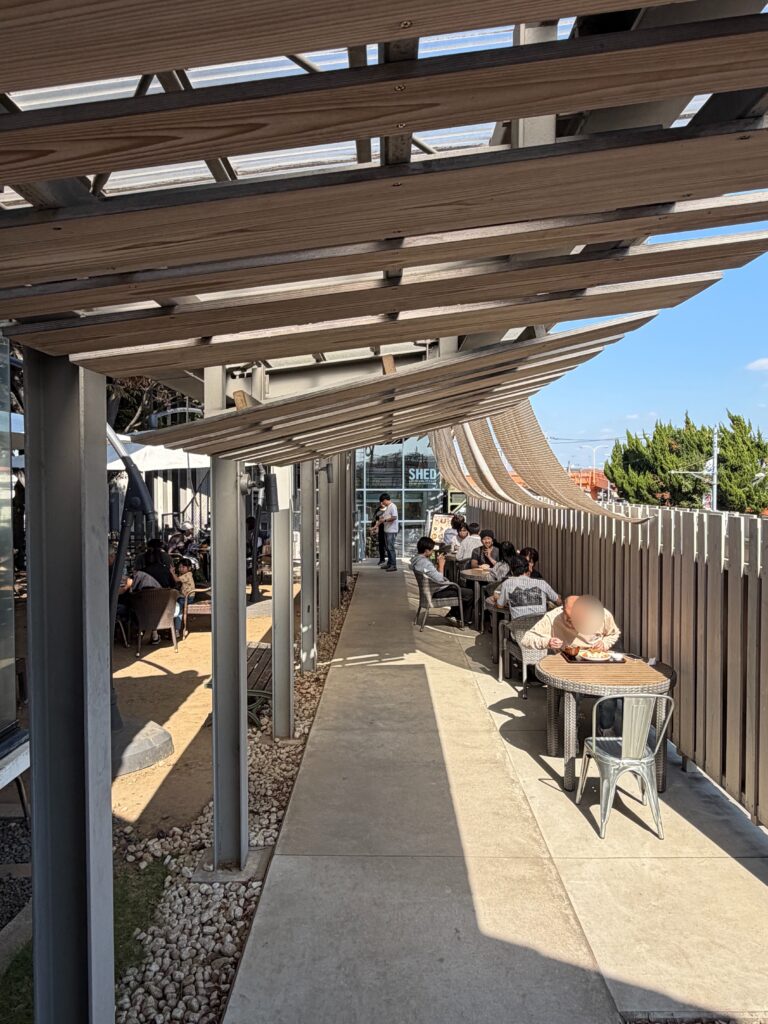
Don’t let the storehouse look fool you: the restaurant inside is now SHED, a casual café-restaurant using local ingredients. The menu changes with the seasons and has included steak rice bowls, pasta, hamburg steak and bento boxes. Between the building and the roadside station runs a semi-outdoor walkway with tables, shaded by another wooden louver roof in Kuma’s typical style. On a fine day, it is a lovely, relaxed place for lunch.
Across the road from the roadside station is a shopping area with a Kasumi supermarket, Don Quijote and Mister Donut, and Goroko-no-Yu, a large public bathhouse, if you would like to end your day with a soak. Just to the south flows the Tone River, crossed by the Sakai-Ōhashi Bridge to Sekiyado in Chiba Prefecture.
The town bus (and the self-driving bus)
Sakai is famous in Japan for another reason: in 2020, it became the first town in the country to run self-driving buses on public roads every day as regular public transport, using small electric buses made by the French company Navya. As of October 2026, however, the self-driving buses are out of service for long-term maintenance, and no restart date has been announced. A regular bus with a driver runs on the same route and timetable instead, and it is still free.
For this walk, take the bus from Sakai Highway Bus Terminal to the Sakahana-cho stop, right in front of the café. After that, everything is within walking distance.
Best time to go
Thursday to Saturday. Each place has different closing days, so on Sunday to Wednesday, something will be closed: the café closes on Tuesdays and Wednesdays, S-Gallery on Mondays and Tuesdays, and S-Lab was closed on the Sunday I visited. Go on a sunny day if you can. The louvers look their best when the light throws strong shadows.
Good to know before you go
- Check the bus home first. Highway buses back to Tokyo are not frequent, so check the timetable before you set off.
- Trains are slow here. Sakai has no train station. By train, you need a local bus from Tobu-Dobutsu-Koen or Koga Station, so the highway bus is much easier.
- Not a big sightseeing spot. This is a quiet working town, not a tourist attraction. Come for the architecture, the food and the calm, not for crowds or souvenir streets.
- Opening hours (as of October 2026): Michi-no-Eki Sakai and Sakai Sand, usually 9:30–17:00 (10:00–17:00 on weekends, hours vary by day). SHED, 10:00–17:00. HOSHIIMONO100 Café, 10:00–18:00 (last order 17:00), closed Tuesdays and Wednesdays. S-Gallery, 10:00–12:00 and 13:15–17:00, closed Mondays and Tuesdays, ¥330.
Getting there
- Highway bus (easiest): Tokyo Station, Yaesu South Exit, to Sakai Highway Bus Terminal, via Oji Station. About 1 hour 30 minutes, ¥1,800 (JR Bus Kanto and Kanto Railway). Then take the free town bus to Sakahana-cho.
- By train and bus: Tobu Nikko Line to Tobu-Dobutsu-Koen Station, or JR Utsunomiya Line to Koga Station, then an Asahi Bus bound for “Sakai Shako.” Get off at “Sakai-machi Yakuba Iriguchi.”
- By car: the buildings have parking.
Book your trip
Highway bus
You can check timetables and reserve seats on the operator’s official site.
Stay connected
Out in the countryside, you will want mobile data for bus timetables and maps.
Official websites
- Michi-no-Eki Sakai (Japanese)
- Hoshiimono Hyakka (Japanese)
- S-Gallery Shukusanpō Museum (Japanese)
Next time
In Part 3, we return to Tokyo and walk from Aoyama to Harajuku, from the bamboo-lined approach of the Nezu Museum to the forest of Meiji Jingu, to see how Kuma brings wood and green into the heart of the city.
Photos: Aozora Walks. Information as of October 2026. Sources: Ministry of Finance, Japan, “Finance” (December 2022); official websites of each facility.