
This post contains affiliate links. If you book through them, I may earn a small commission at no extra cost to you.
A train with no driver, running on rubber tires, climbing in a loop and gliding across Rainbow Bridge between an expressway and the sea. It sounds like a theme-park ride, but it is an ordinary commuter line: the Yurikamome.
In Part 3, we sailed down the Sumida River from Asakusa to Odaiba by water bus. This time we take the other way home. As a geography teacher, I love this 15-minute ride because it shows how Tokyo built a whole new district on reclaimed land in the bay, and then had to squeeze a railway into it.
Quick facts
| Route | Odaiba-kaihinkoen → Rainbow Bridge → Shibaura-futo → Shiodome → Shimbashi |
| Time | About 13 minutes |
| Fare | ¥325 with an IC card / ¥330 ticket (adults) |
| Payment | Suica, PASMO and other IC cards, or contactless credit cards and phones |
| Best seat | The very front, or the very back for photos |
A driverless train on rubber tires
The Yurikamome is not a normal train. It is a “new transit system”: small, computer-controlled cars that run on rubber tires along a concrete guideway, with no driver and no conductor on board. The whole line runs on an elevated track, so you are above the streets for the entire ride.
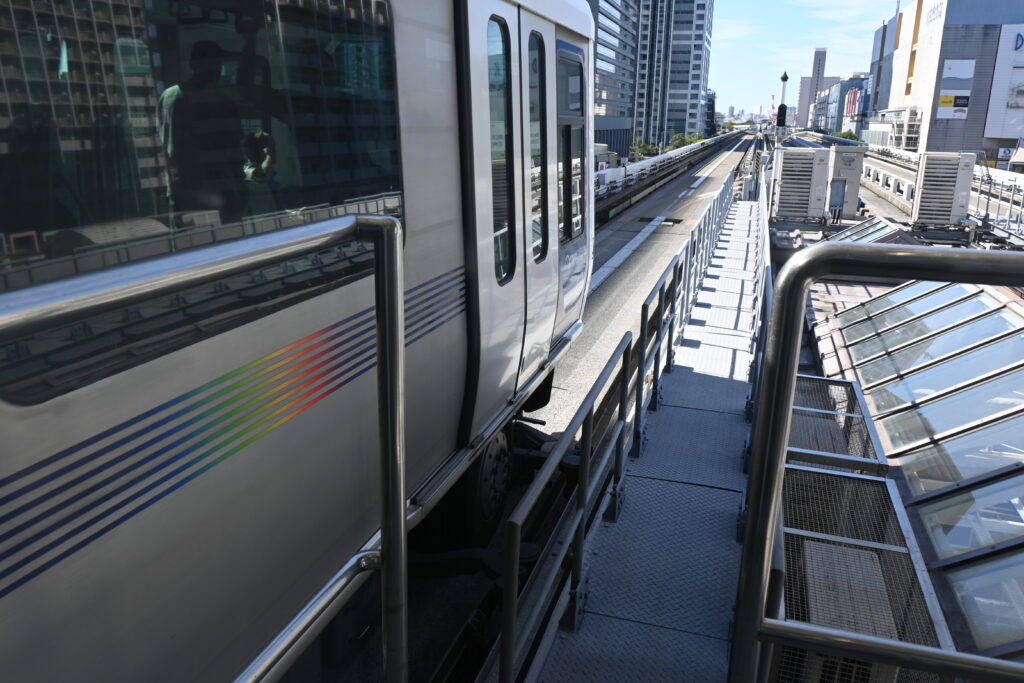
Rubber tires grip better than steel wheels on rails, so the Yurikamome can handle steep slopes and sharp curves. That matters here. The line was built after the roads and expressways around it, so it had to weave over, under and between them. The result is a ride with surprising climbs, drops and turns that you will not find on most railways.
There is a story behind it, too. The line opened in November 1995, planned for the World City Expo that Tokyo was to host on this waterfront in 1996. The expo was cancelled during construction, and for a while the new trains ran through almost empty reclaimed land. In Odaiba, the railway came before the city.
Then and now: Odaiba was once the sea
Where did the name “Odaiba” come from? In 1853, American warships under Commodore Perry sailed into Edo Bay, and the shogunate hurried to build a line of small island forts, called daiba, in the sea off Shinagawa to defend the city. Only two of them survive today: No. 3, now Daiba Park, and No. 6, an overgrown island you can see from the bridge. The whole Odaiba district, and the name itself, grew from these forts.
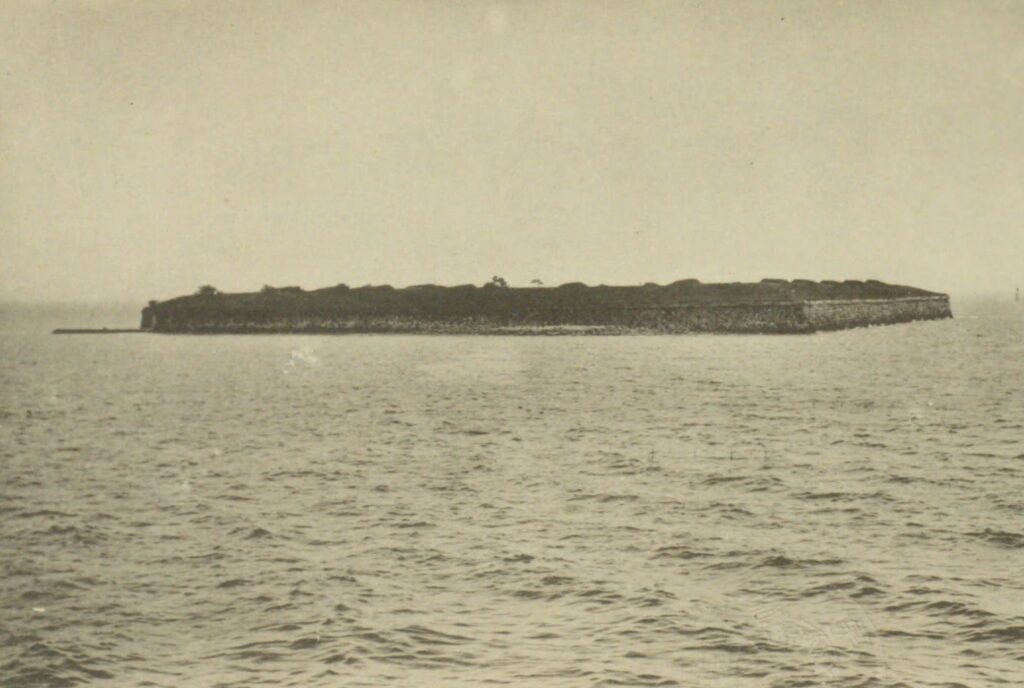
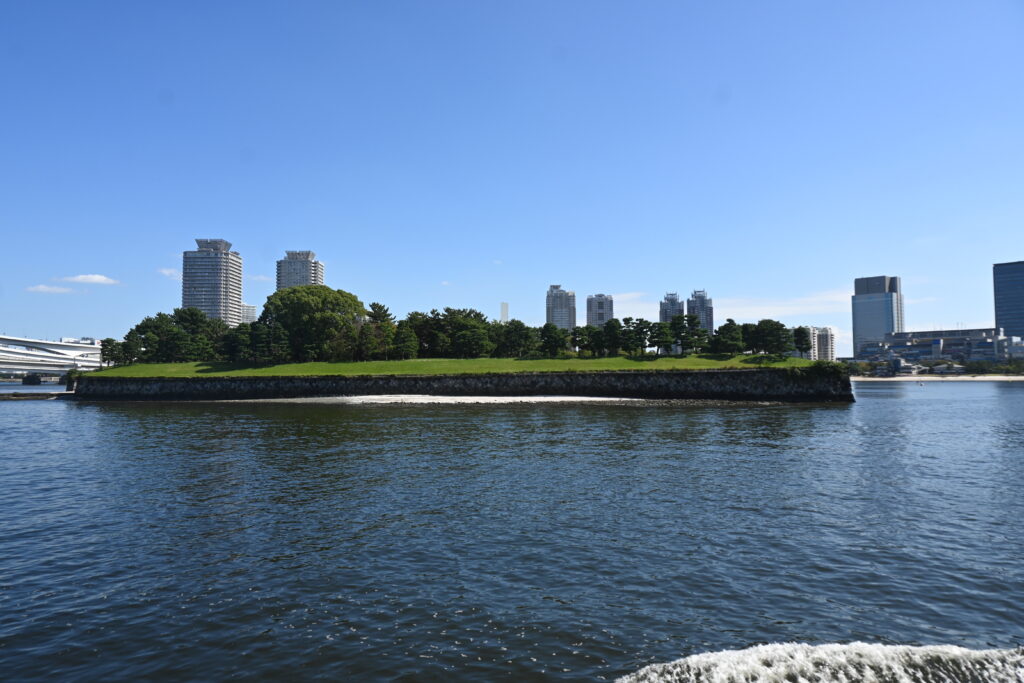
What stayed the same: the stone walls. The low, angled walls of the fort are the same ones you can see in the 1927 photograph, built more than 170 years ago.
What changed: everything around them. In 1927 the fort sat alone in open water, with nothing but sea and sky behind it. Today pine trees and grass cover the top, a sandy beach runs beside it, and the high-rises of Odaiba stand where there was once only sea. The Yurikamome you are about to ride runs across land that did not exist a century ago.
Daiba Park, on top of the No. 3 fort, is free and open at all times, about a 20-minute walk along the beach from Odaiba-kaihinkoen Station. If you have time before your train, walk along the old stone walls.
Starting at Odaiba-kaihinkoen
If you arrived by water bus, walk inland from the pier to Odaiba-kaihinkoen Station. There are coin lockers by the ticket gates, handy if you are carrying shopping bags or luggage.
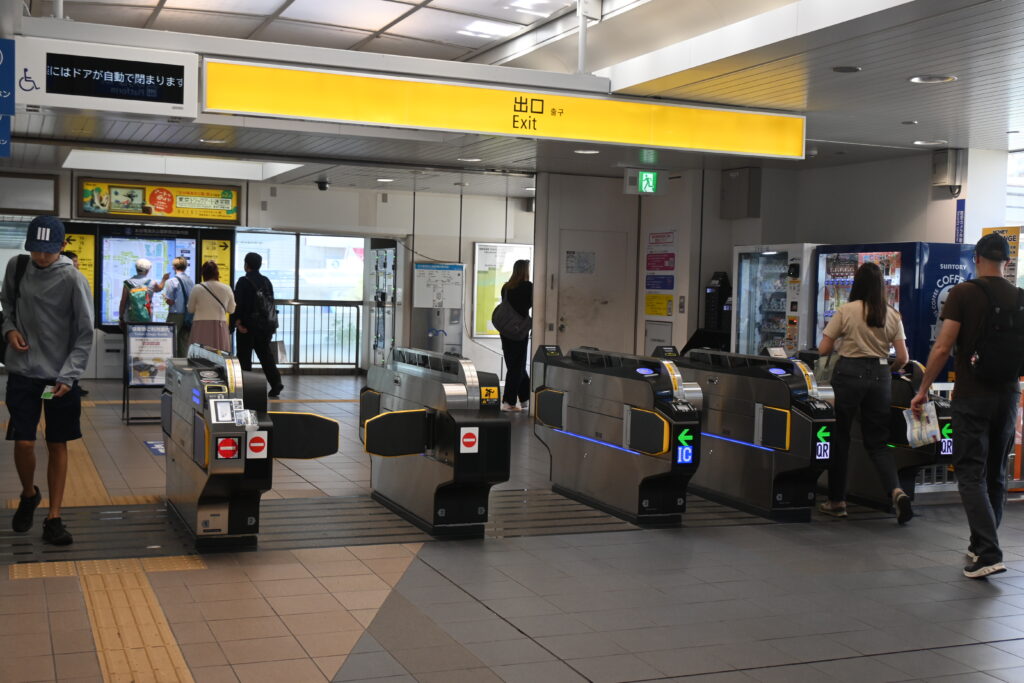
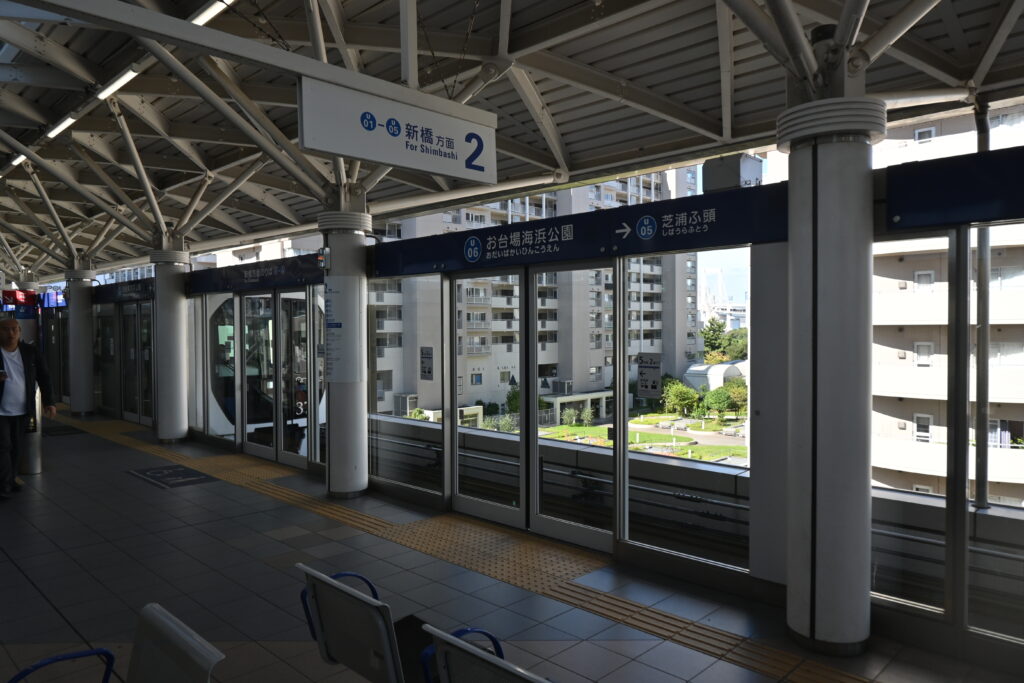
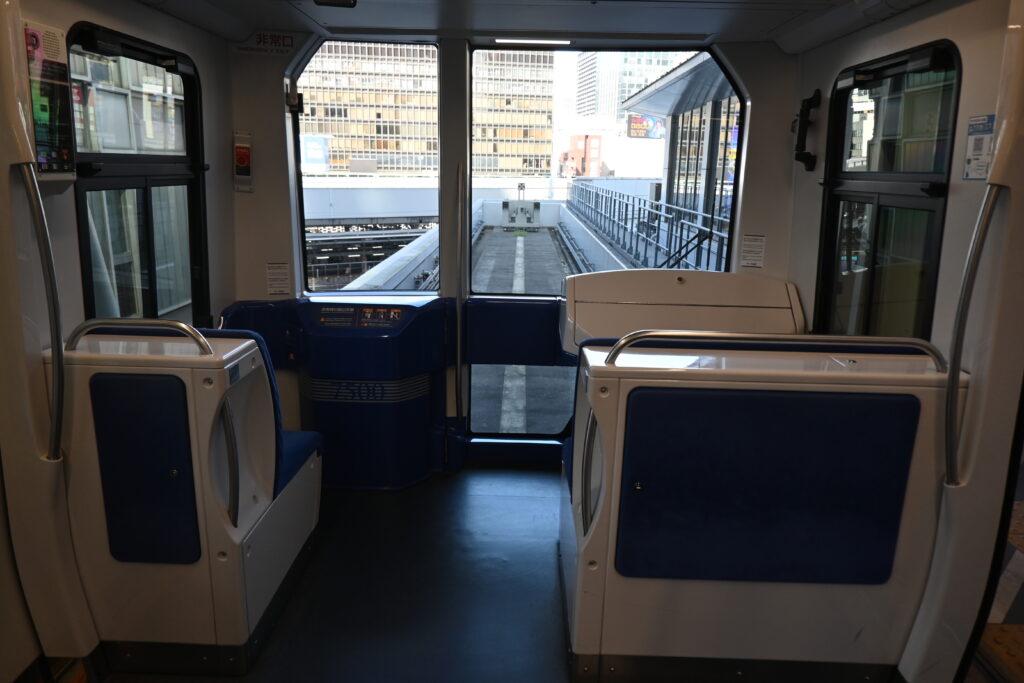
Platforms have screen doors, and trains come every few minutes. Here is the fun part: with no driver’s cab, the front of the train is just a big window with seats behind it.
Crossing Rainbow Bridge
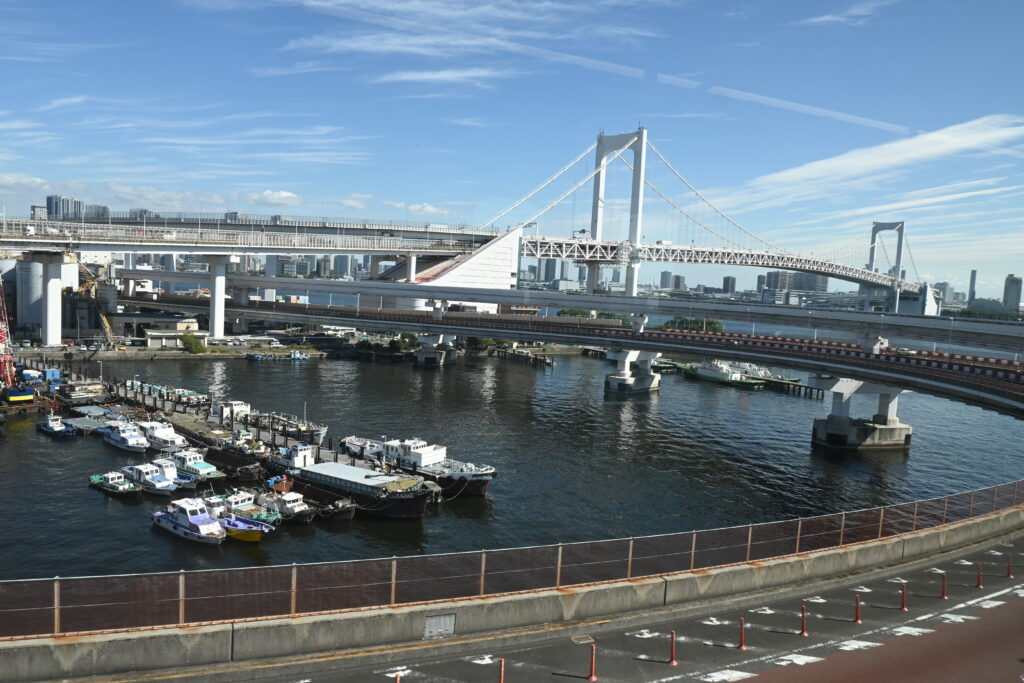
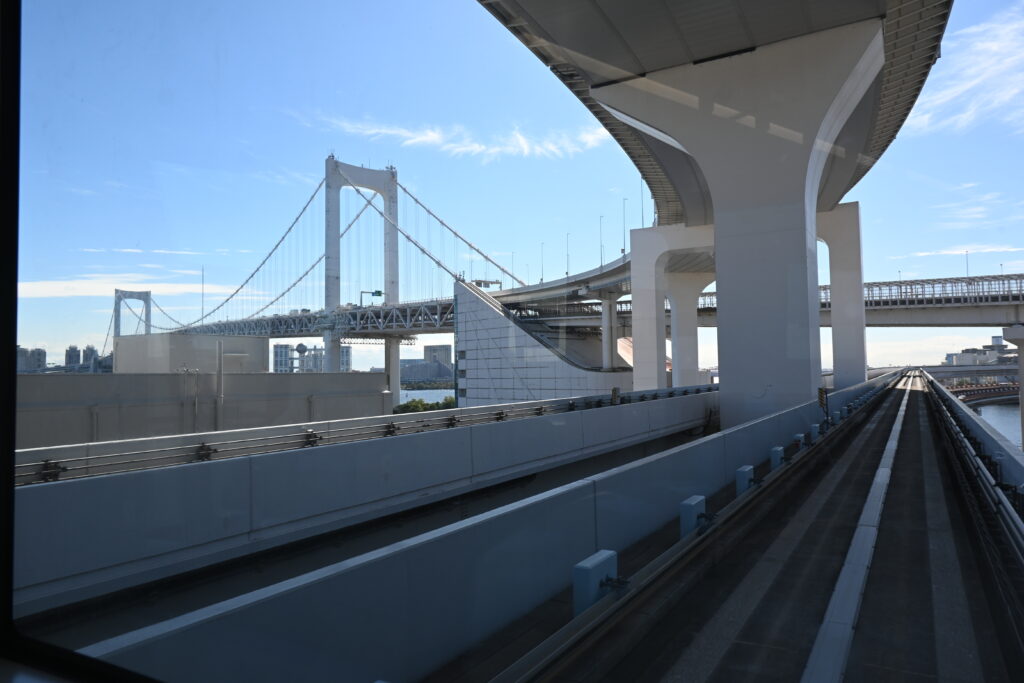
Soon after leaving Odaiba-kaihinkoen, the train heads onto Rainbow Bridge. This is a two-level bridge. The Yurikamome runs down the middle of the lower deck, with the Shuto Expressway directly above you and ordinary road lanes on both sides at the same level. The track is wrapped in mesh, so it feels like riding through a tube in a science-fiction film. On a clear day, the white towers stand out sharply against the blue sky.


At the Shibaura end, the train swings around a big loop. The bridge deck is high above the water so that ships can pass underneath, and the loop is how the track and the road climb up to it, and back down, in the little space available on the shore.
You can walk across it, too!
Rainbow Bridge has free walkways, the Rainbow Promenade, on the outer edges of the lower deck. The walk is about 1.7 km and takes around 30 minutes between the Shibaura side and the Odaiba side. You choose the north route (views of Tokyo Tower, Tokyo Skytree and the city) or the south route (views of Odaiba and the old Daiba fort) at the entrance, and you cannot switch halfway. One fun plan: walk across one way and ride the Yurikamome back.
- Open 9:00–21:00 from April to October, and 10:00–18:00 from November to March. Last entry 30 minutes before closing.
- Closed on the third Monday of each month (the next day if it is a holiday).
- No cycling, no tripods. Pets and folding bikes are allowed only if carried in a bag.
- The Shibaura entrance is about 5 minutes from Shibaura-futo Station; the Odaiba side is about 10 minutes from Odaiba-kaihinkoen Station.
Between the skyscrapers
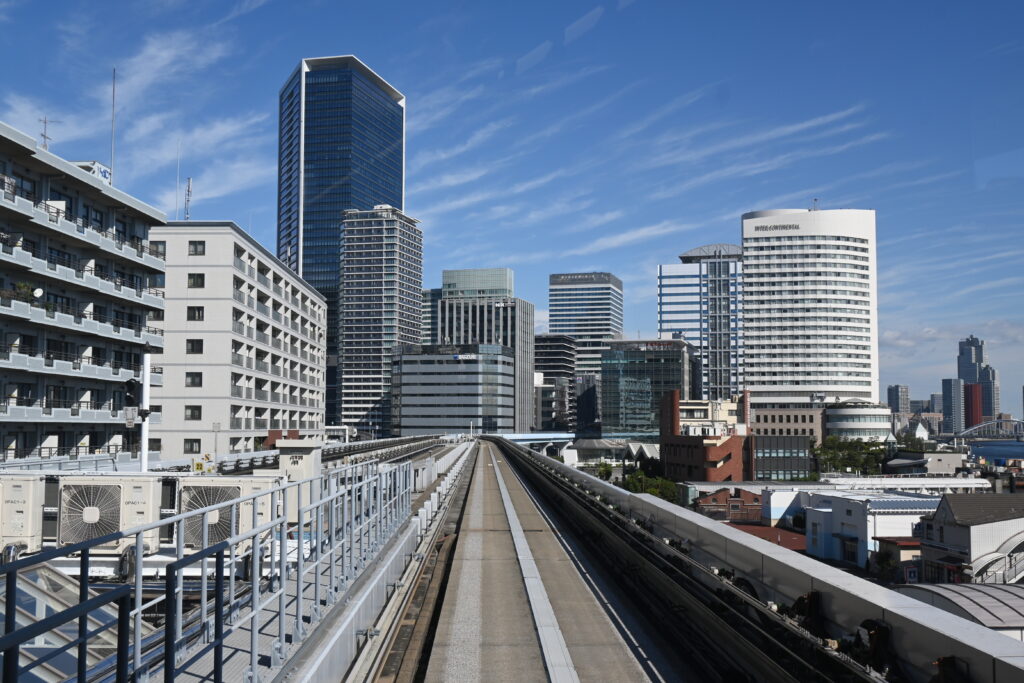
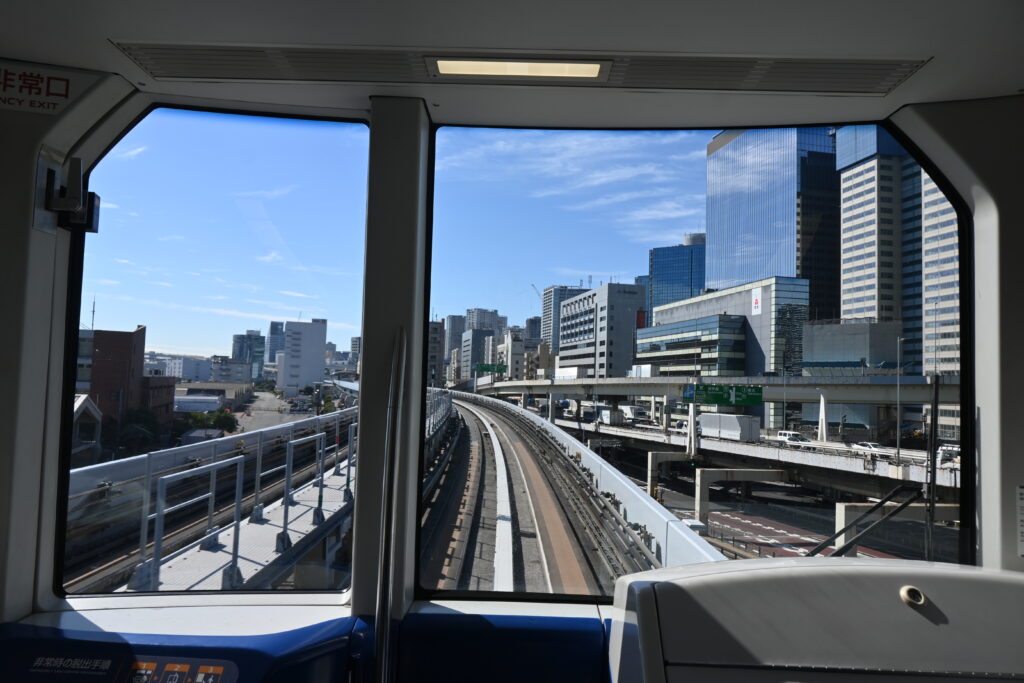
After Shibaura-futo, the line curves north toward Shimbashi, and this is where the “roller coaster” feeling kicks in. The track dips, rises and bends between office towers, sometimes so close that you can almost look into the windows.
Tip: front for the thrill, back for the photos
Because there is no driver, the last car has the same big window as the first. I took most of the photos in this article from the very back, and I think the back is actually better for photos. But both ends have great views, and the front is more exciting, especially for kids.
Arriving at Shimbashi
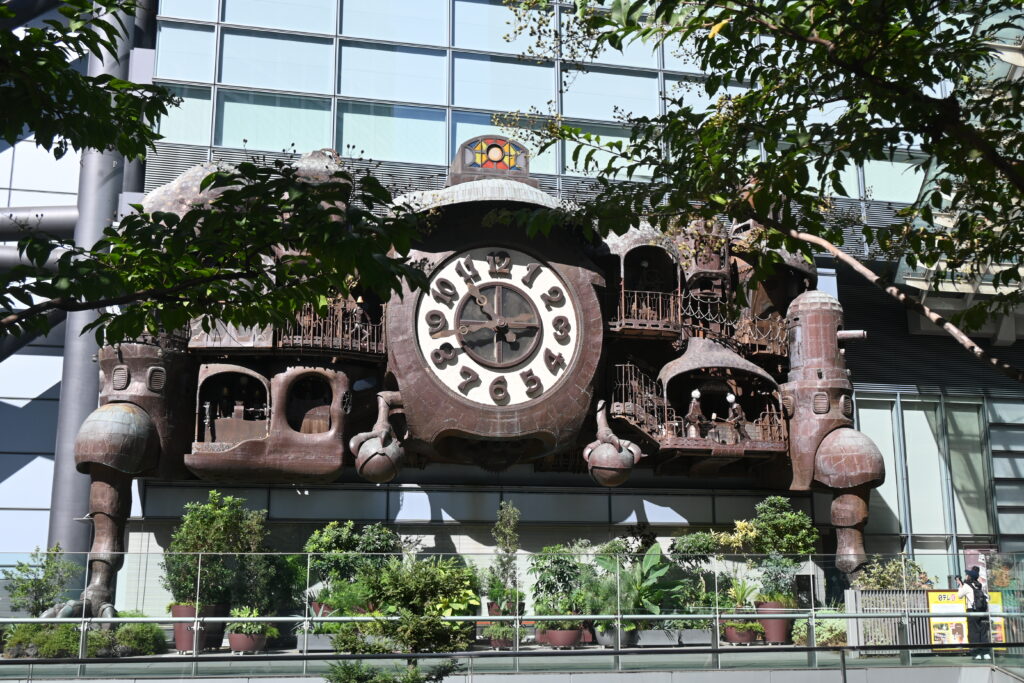
The line ends at Shimbashi, one of Tokyo’s busiest business districts. Just before you arrive, look for the Shiodome skyscrapers. Outside the Nippon TV building at Shiodome stands a giant clock designed by Hayao Miyazaki, the director of Spirited Away and My Neighbor Totoro. It “performs” several times a day.
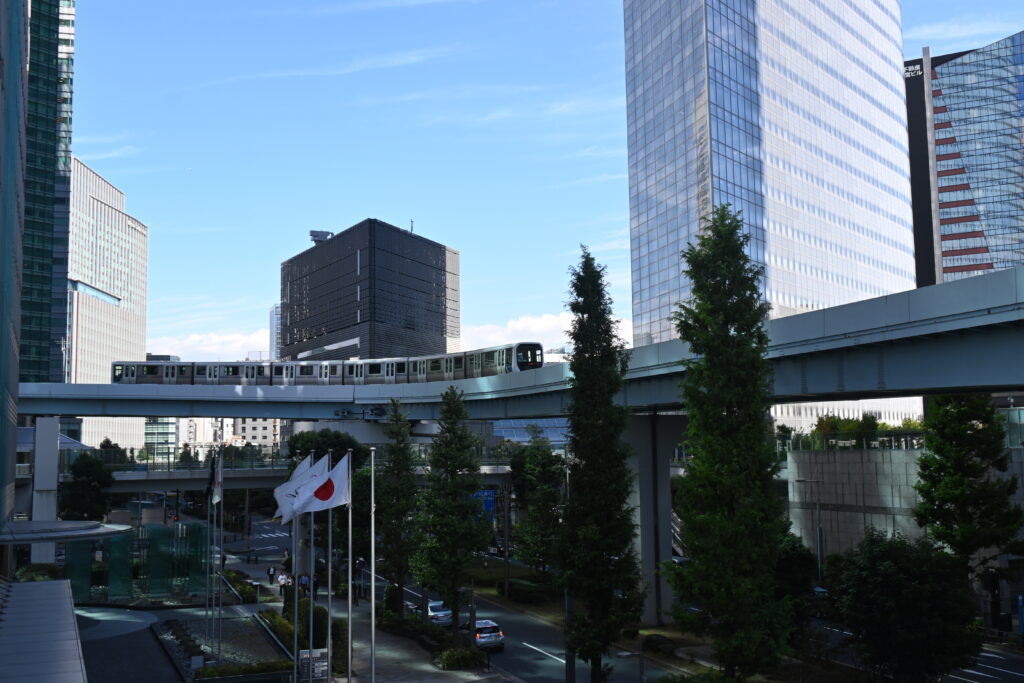
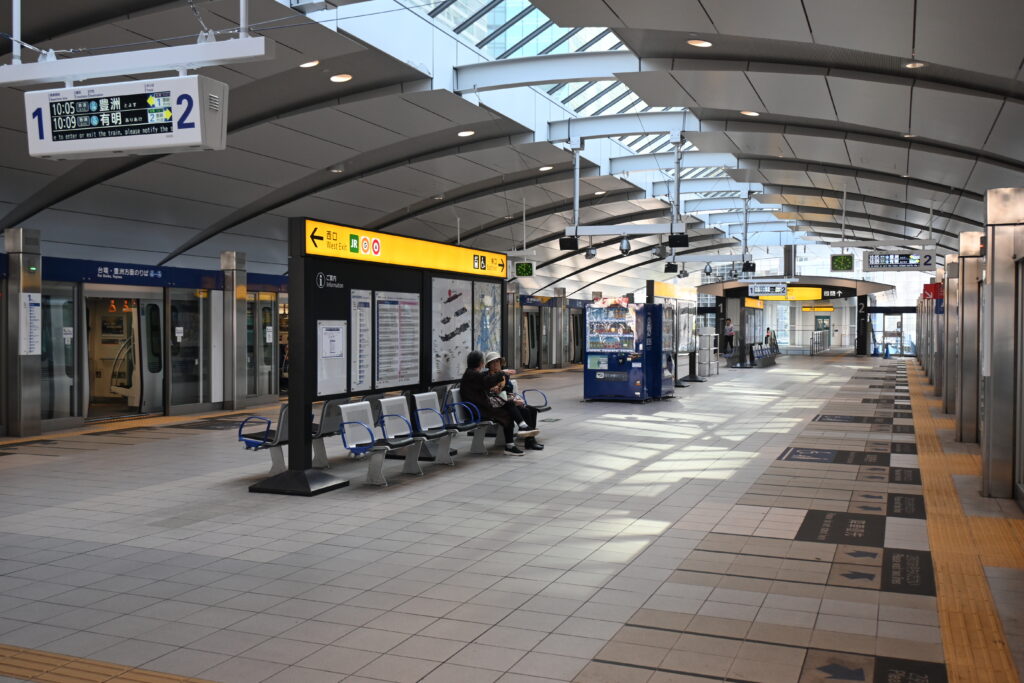
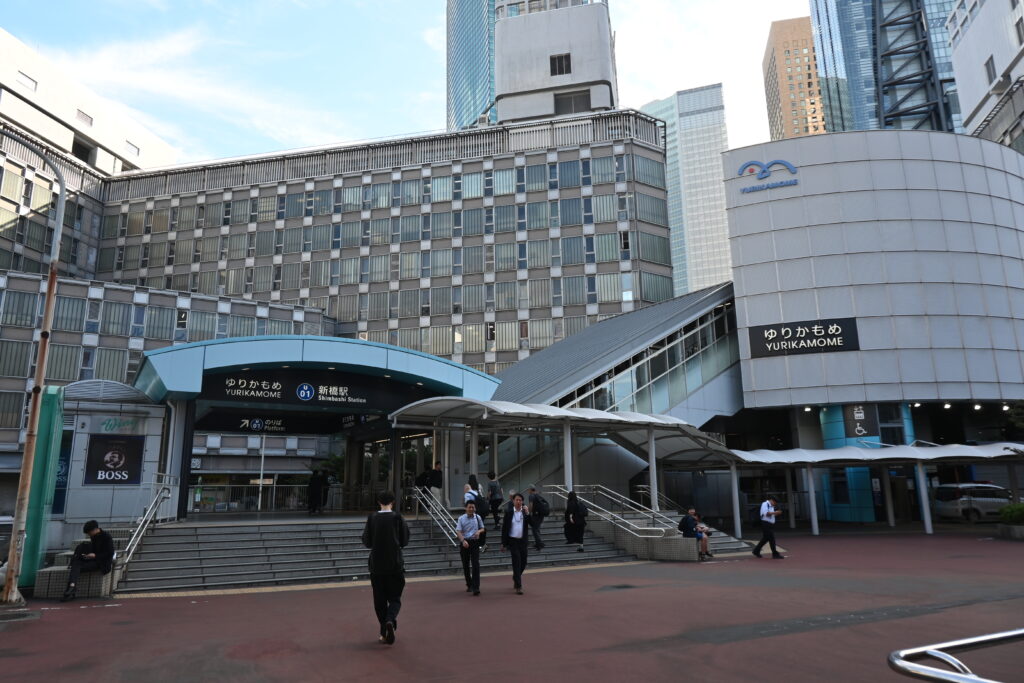
From Shimbashi, you can change to the JR lines, the Toei Asakusa Line, or the Ginza Line. The Ginza Line takes you straight back to Asakusa, or to Nihonbashi for our next walk.
Best time to go
- Weekday daytime is the easiest time to get a front seat.
- Weekends, school holidays (especially spring and summer), and big event days at Tokyo Big Sight are very crowded.
- Go in clear weather if you can: the views of the bay and the white towers of Rainbow Bridge are at their best.
Good to know before you go
- Check for events. When Tokyo Big Sight or other Odaiba venues hold a big event, the Yurikamome can be packed. Check the Tokyo Big Sight event calendar before you go.
- Want the front seat? Wait for two trains. Shimbashi and Toyosu, the two ends of the line, have only two tracks each. Let the train waiting at your platform leave, then the one from the other track, and you will be at the head of the line for the front seats on the next train. It works every time, even when it is busy.
- Check the direction. At the end stations, trains reverse and leave in the direction they came from. Make sure you are on the right platform.
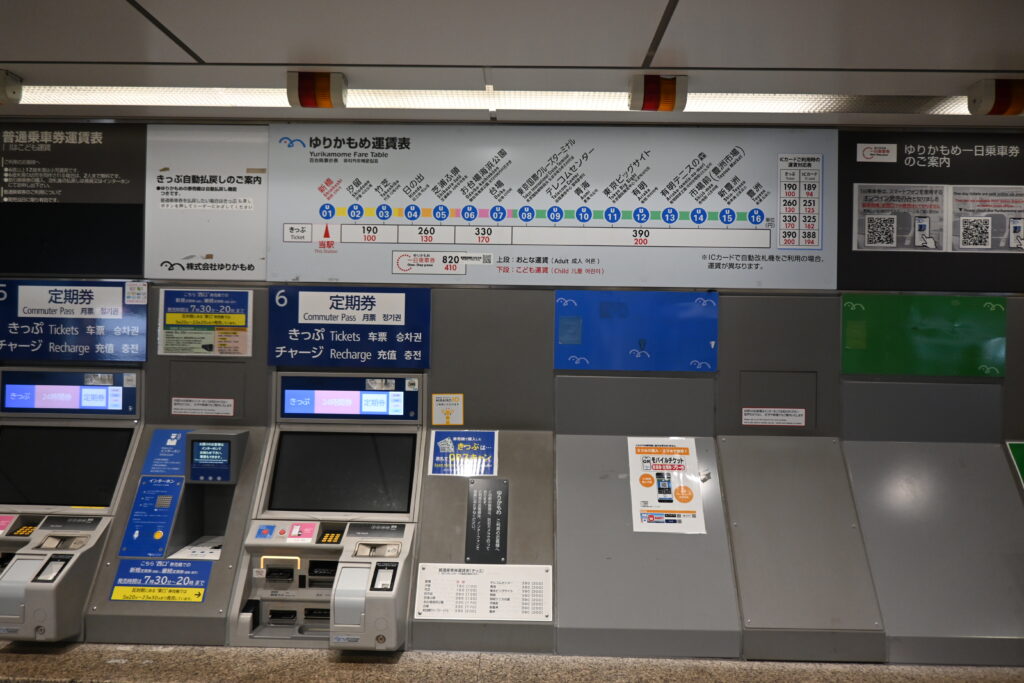
- Paying the fare. You can tap an IC card such as Suica, or a contactless credit card or phone at the gate. With contactless cards, the total fare for one day is capped at ¥820 (same card and same device). The old magnetic one-day pass is no longer sold. Check the official Yurikamome website for the latest details.
Tip: you will need mobile data for route searches, and some contactless payments use your phone. An eSIM is the easiest option for visitors.
Getting there
- From Odaiba: Yurikamome Odaiba-kaihinkoen Station, about 13 minutes to Shimbashi.
- From the water bus: walk from Odaiba Seaside Park pier to Odaiba-kaihinkoen Station.
- From Shimbashi: JR, Tokyo Metro Ginza Line and Toei Asakusa Line all connect.
Make a day of it
teamLab Planets
If you have more time, stay on the Yurikamome the other way, toward Toyosu. Near Shin-Toyosu Station is teamLab Planets, an immersive digital art museum where you walk barefoot through rooms of light, mirrors and water.
This ticket on GetYourGuide is the official entry ticket, with timed entry. Same-day booking is not possible, tickets are non-refundable, and you must enter within 30 minutes of your time slot. Prices may change and may differ from the official site, so compare before you book.
Where to stay
Hilton Tokyo Odaiba
Why choose: A bayside hotel next to Daiba Station on the Yurikamome, close to Rainbow Bridge and the Odaiba waterfront.
Grand Nikko Tokyo Daiba
Why choose: A large hotel by Daiba Station, convenient for exploring Odaiba and riding the Yurikamome in the quiet morning hours.
Park Hotel Tokyo
Why choose: In the Shiodome skyscrapers at the Shimbashi end of the line, with easy access to Ginza and the Ginza Line.
Next time
From Shimbashi, we take the Ginza Line to Nihonbashi, the bridge where all of Japan’s old highways began. Stone bridges, a department store with a giant goddess, and an expressway that will soon disappear: Tokyo’s past and future, side by side.
Photos: Aozora Walks unless otherwise noted. The No. 3 Daiba fort in 1927: “Shinagawa Daiba” (Tokyo City Parks Division, 1927), National Diet Library Digital Collections (public domain).