
This post contains affiliate links. If you book through them, I may earn a small commission at no extra cost to you.
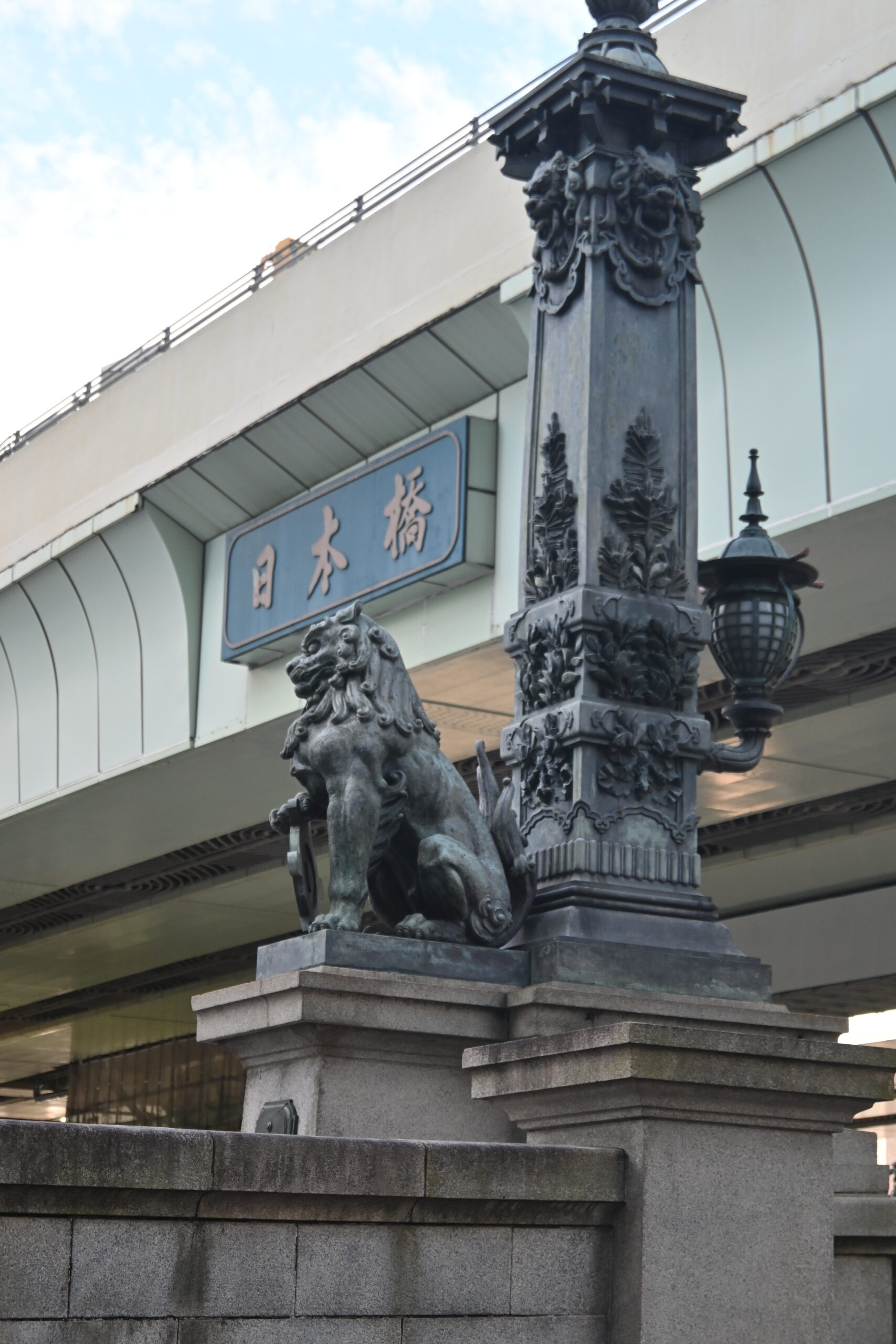
Stand in the middle of Nihonbashi and look up. Instead of sky, you see the underside of an expressway. Look down, and there is a small bronze plate in the road: the point from which distances across Japan are still measured. This bridge was the starting point of the old highways of Edo, and today it is one of the best places in Tokyo to see how the city keeps rebuilding itself.
In the last post, we rode the Yurikamome back from Odaiba to Shimbashi. From there, the Ginza Line takes you to Nihonbashi in a few minutes. As a geography teacher, I think this short walk explains more about Tokyo than almost anywhere else: the roads, the river, the fish market, the first department store, the central bank and the gates of Edo Castle, all within about one kilometer.
Quick facts
| Route | Nihonbashi Station → Nihonbashi bridge → fish market memorial → Mitsukoshi → COREDO Muromachi → Bank of Japan → the three Tokiwa bridges |
| Distance | About 1.5 km on flat ground |
| Time | 2 to 3 hours with stops (1 hour if you only walk) |
| Cost | Free to walk. River cruises from ¥2,500 (optional) |
| Nearest stations | Nihonbashi or Mitsukoshimae (Tokyo Metro Ginza Line) |
Start: Nihonbashi Station
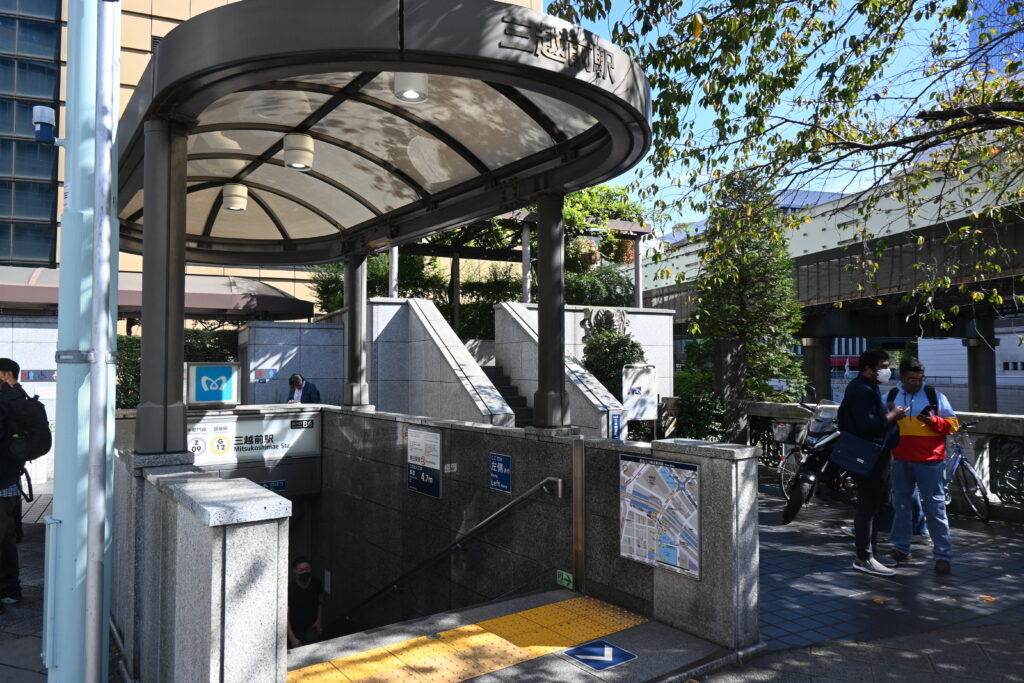
From Nihonbashi Station on the Ginza Line, take Exit B10. You come up on Chuo-dori, the main street. Walk to the next big intersection and turn right, and the bridge appears under the expressway.

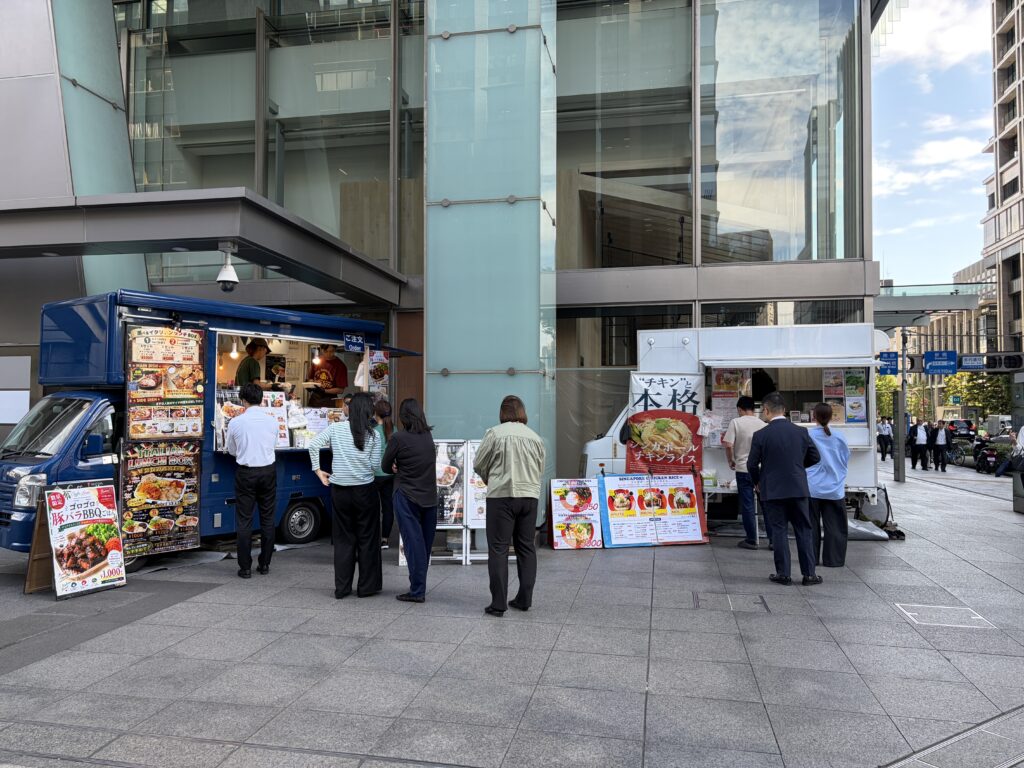
Right outside Exit B10, on the south-east corner of the Nihonbashi intersection, food trucks park at lunchtime, selling bento boxes to office workers. A handy stop if you want to eat before you start walking.
The bridge where all roads began
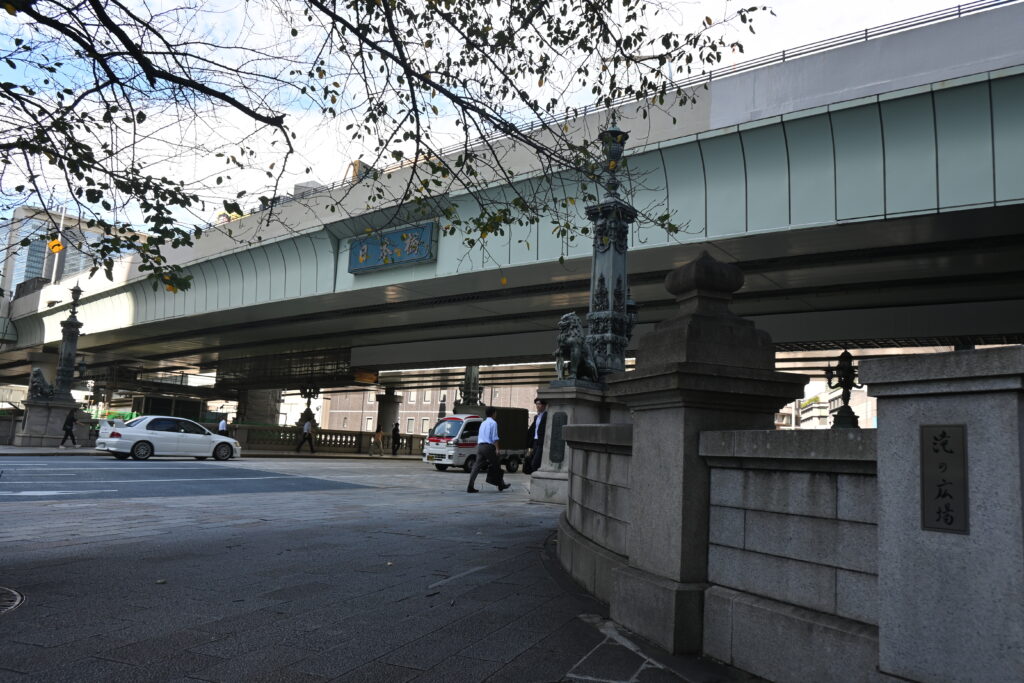
The first Nihonbashi, a wooden bridge, was built in 1603, the year Tokugawa Ieyasu became shogun. Soon after, the shogunate made it the starting point of the five main highways of Japan, including the Tokaido to Kyoto. Travelers, goods and news all passed over it. The name simply means “Japan Bridge”.

The wooden bridge burned and was rebuilt many times. The stone bridge you see today was completed in 1911. It is the 20th Nihonbashi, and it became a national Important Cultural Property in 1999.
Lions, kirin and the last shogun
The bronze decorations on the bridge are wonderful, so take your time. The lions hold the crest of the city of Tokyo. The creatures with wings are kirin, mythical animals. They are often said to have wings so that they can fly from the starting point of Japan’s roads to every corner of the country.
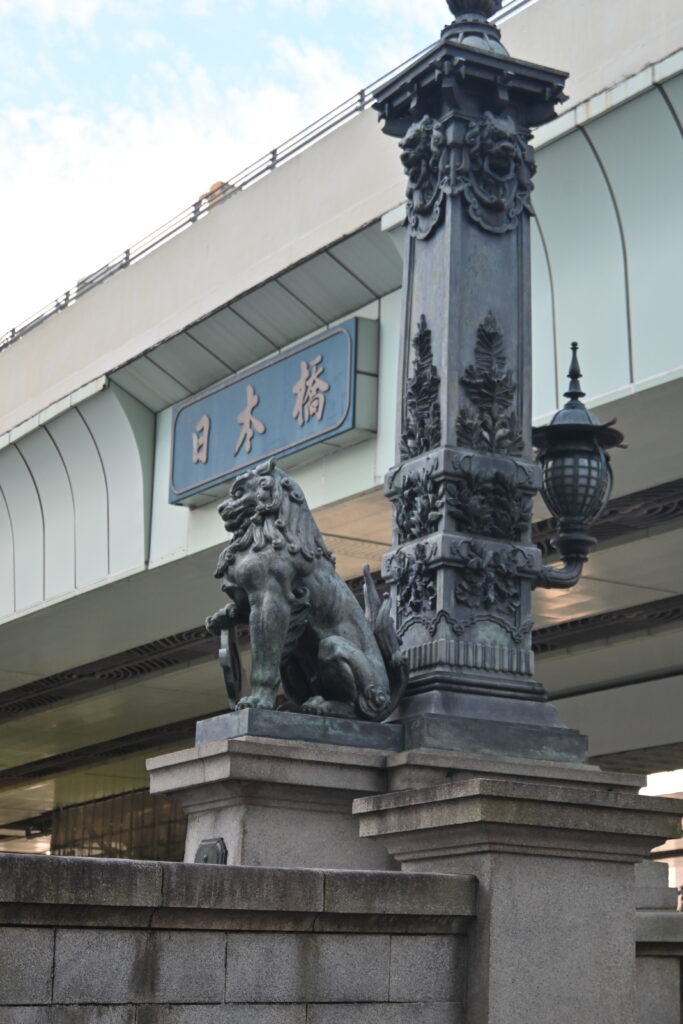

Look at the name plates on the bridge posts. The characters “日本橋” were written by Tokugawa Yoshinobu, the last shogun. The same characters appear on the side of the expressway above, copied from the plates. Even the expressway pays its respects to the bridge.
Scars from 1945
Now look closely at the stone railings. The dark stains are burn marks, and a sign on the bridge explains that they were left by the Great Tokyo Air Raid of 1945. Incendiary bombs fell on the bridge and burned on the stone. Nobody painted over them.
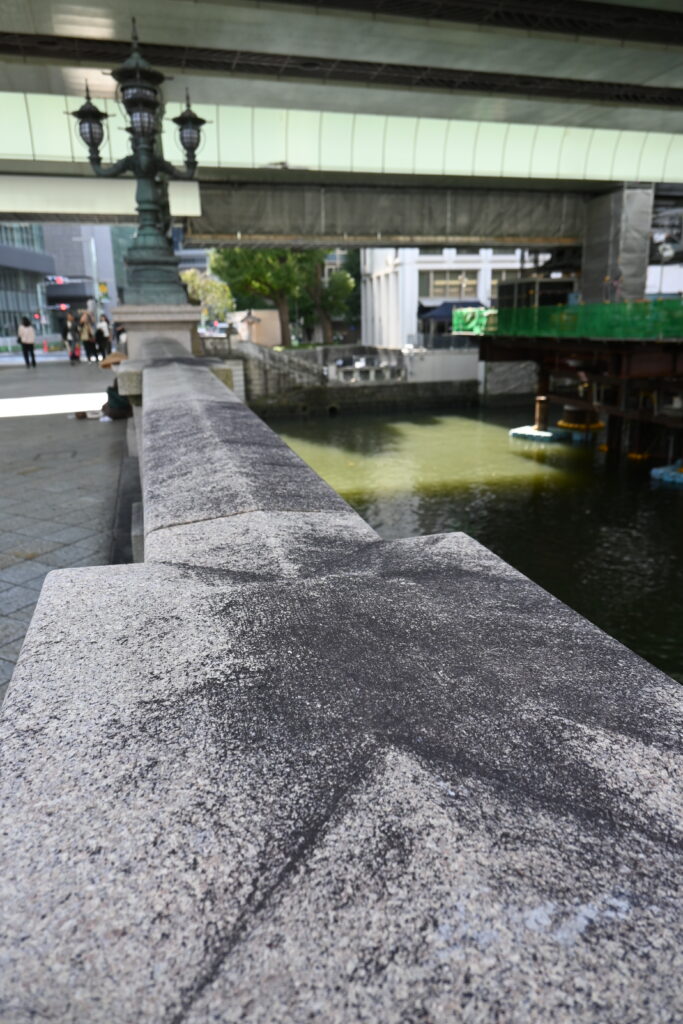
On the night of 10 March 1945, American bombers dropped incendiary bombs over the wooden neighborhoods of eastern Tokyo. The fires killed an estimated 100,000 people in a single night. Nihonbashi burned, and so did Asakusa: the main hall of Senso-ji was lost that night. If you followed this series from Part 2, you have already seen the ginkgo tree beside Senso-ji that still carries its burn scars. The stone bridge survived. The black marks are its scars, and a small piece of war history you can touch.
Kilometer zero
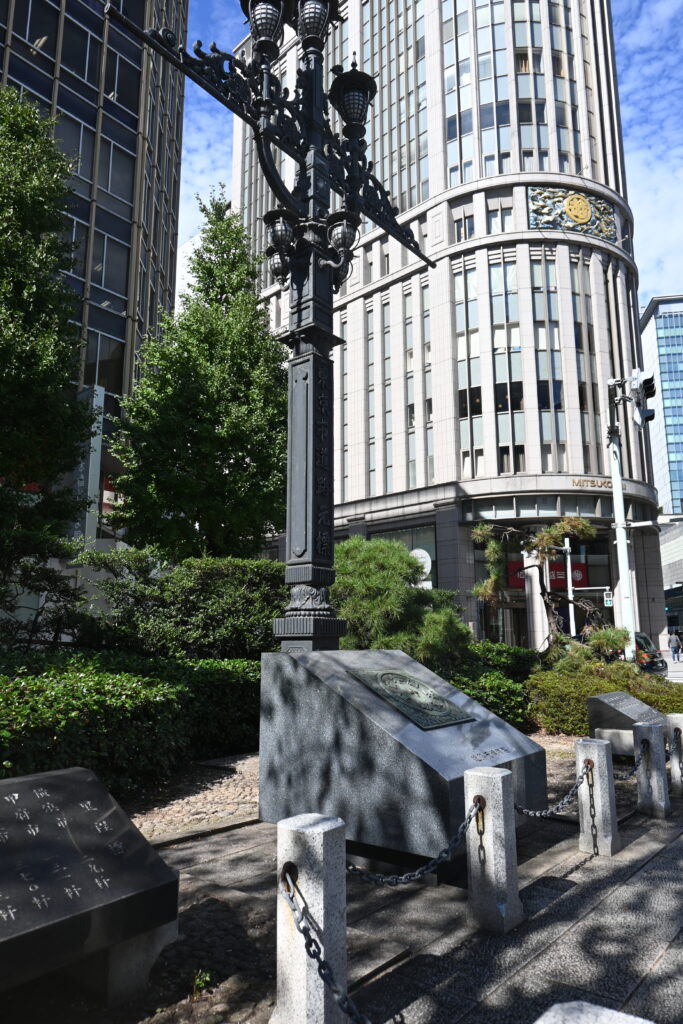
In the middle of the road, between the two lanes, is the Japan Road Origin Marker. Distances on many national roads are still measured from here. You cannot walk into the traffic to see it, but there is a full-size replica at the north end of the bridge, beside the kirin.

Then and now: Hiroshige’s Nihonbashi
The most famous picture of this bridge is the very first print in Utagawa Hiroshige’s series The Fifty-three Stations of the Tokaido, published in the 1830s. A daimyo procession is setting out across the arched wooden bridge at dawn, at the start of the long road to Kyoto.
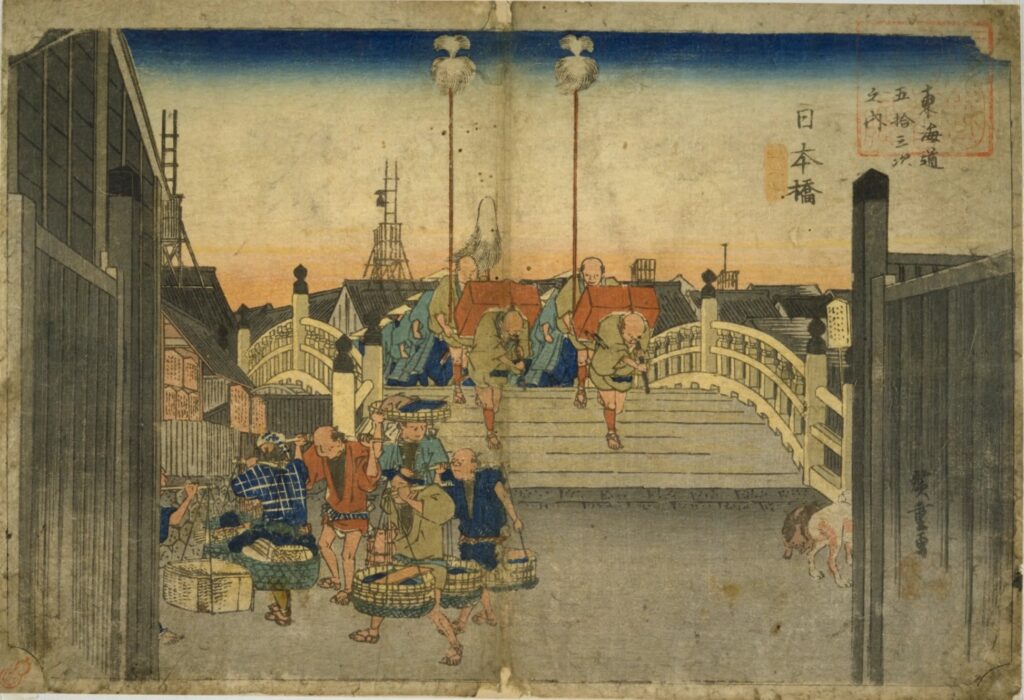

What stayed the same: the place and its role. The bridge still crosses the same river at the same spot, and it is still where Japan’s roads begin. Look at the bottom left of the print, too: men carrying baskets of fish. They are coming from the fish market at the foot of the bridge, which we will visit in a moment.
What changed: almost everything you can see. The high wooden arch became twin stone arches, built low and flat for trams and cars. The wide sky in the print is now covered by the expressway, built in 1963 in a rush before the 1964 Tokyo Olympics, along the river because there was no land left to build on.
And it will change again. The expressway above Nihonbashi is being moved underground. The tunnel is planned to open around 2035, and the elevated road is scheduled to be removed by around 2040. When it is gone, the bridge will see the sky again for the first time in more than 70 years. If you come now, you are seeing a view that will soon be history.
Want to walk across the old wooden bridge from Hiroshige’s print? At the Edo-Tokyo Museum in Ryogoku, the northern half of the wooden Nihonbashi has been rebuilt at full size at the entrance to the permanent exhibition. The museum reopened in March 2026 after a major renovation, and it is the best place to learn more about the history of Edo and Tokyo.
From the river: Nihonbashi Cruise
Walk down to the river pier at the north end of the bridge. From under the bridge you can see the stone arches and the expressway pillars standing in the water.
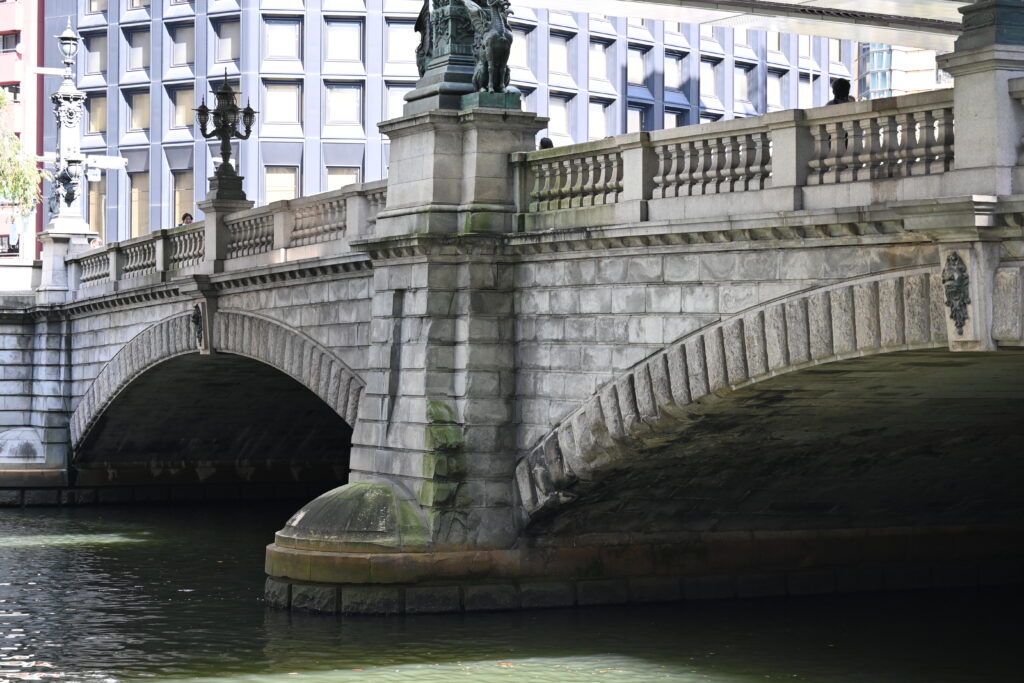
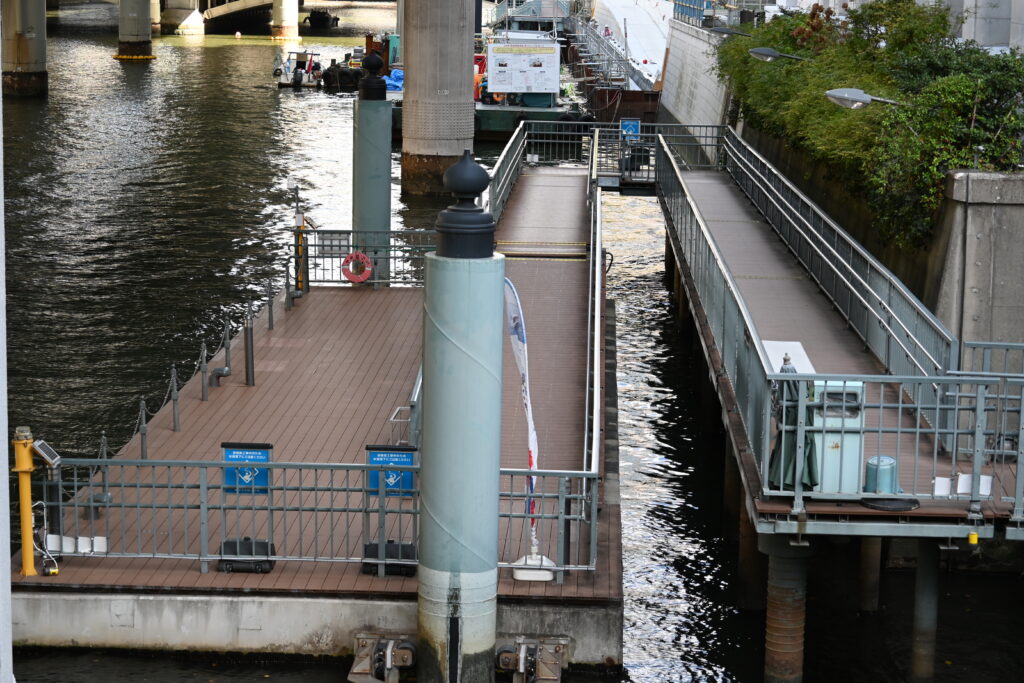
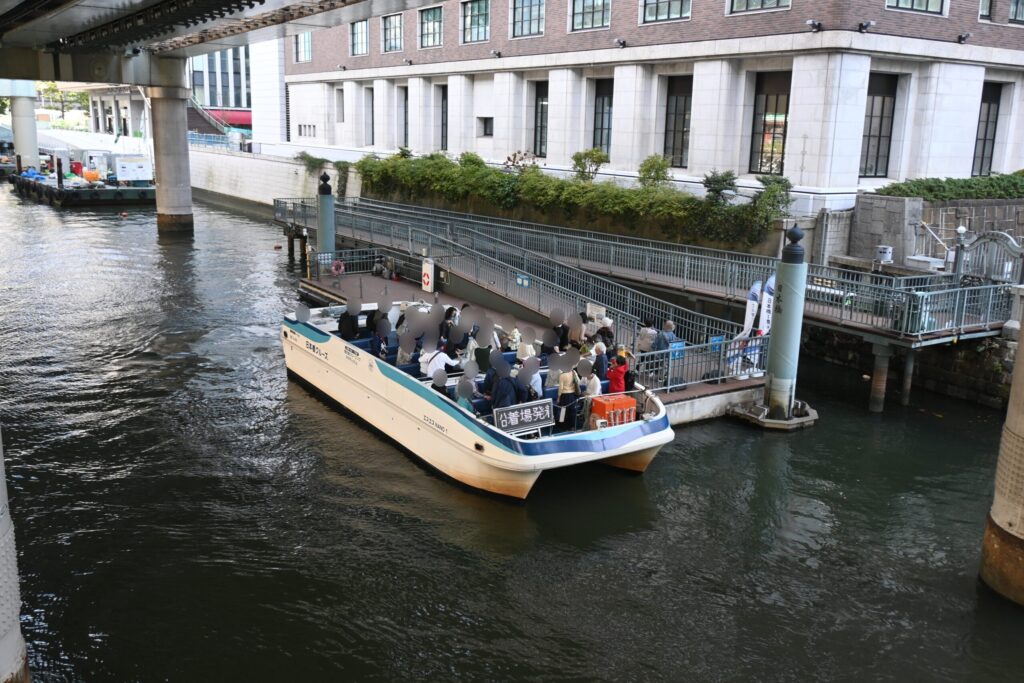
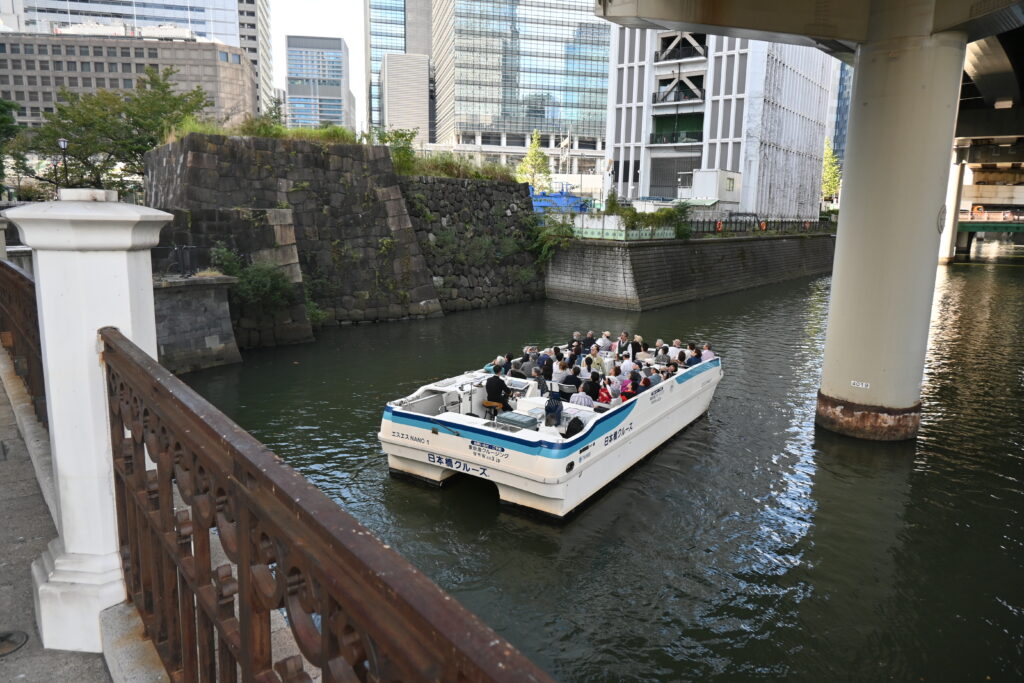
Small open boats run by Nihonbashi Cruise leave from here. The regular course goes around the old moats of Edo Castle along the Nihonbashi and Kanda rivers in about 90 minutes, from ¥2,500 for adults (as of October 2026). I didn’t ride it this time, but I watched the boats come and go, with the guide talking all the way. Note that the commentary is in Japanese. Check the official website for courses, times and booking.
Where the fish market began
Back up on the street, cross to the north-east corner of the bridge. A small monument with a statue of the sea princess Otohime marks the site of Tokyo’s first fish market, the uogashi.
The market began in the early 1600s, when fishermen from Tsukuda village near Osaka, invited to Edo by Ieyasu, started selling the fish left over after supplying the shogun’s castle. Boats brought fresh fish straight up the river to the stalls along the bank. For about 300 years, this was the kitchen of Edo.
The Great Kanto Earthquake of 1923 destroyed it, and the market moved to Tsukiji, then in 2018 to Toyosu. To be honest, nothing of the market is left. There is only the monument. But if you remember the fish carriers in Hiroshige’s print, the empty riverbank tells its own story.
Mitsukoshi: from kimono shop to department store
Walk north on Chuo-dori to Mitsukoshi. Its roots go back to 1673, when the Mitsui family opened a kimono shop called Echigoya. Echigoya became famous for a new idea: fixed prices, paid in cash, displayed openly. At the time, most shops negotiated prices and sold on credit to rich customers. Echigoya sold to everyone at the same price, and it grew into one of the biggest stores in the world.
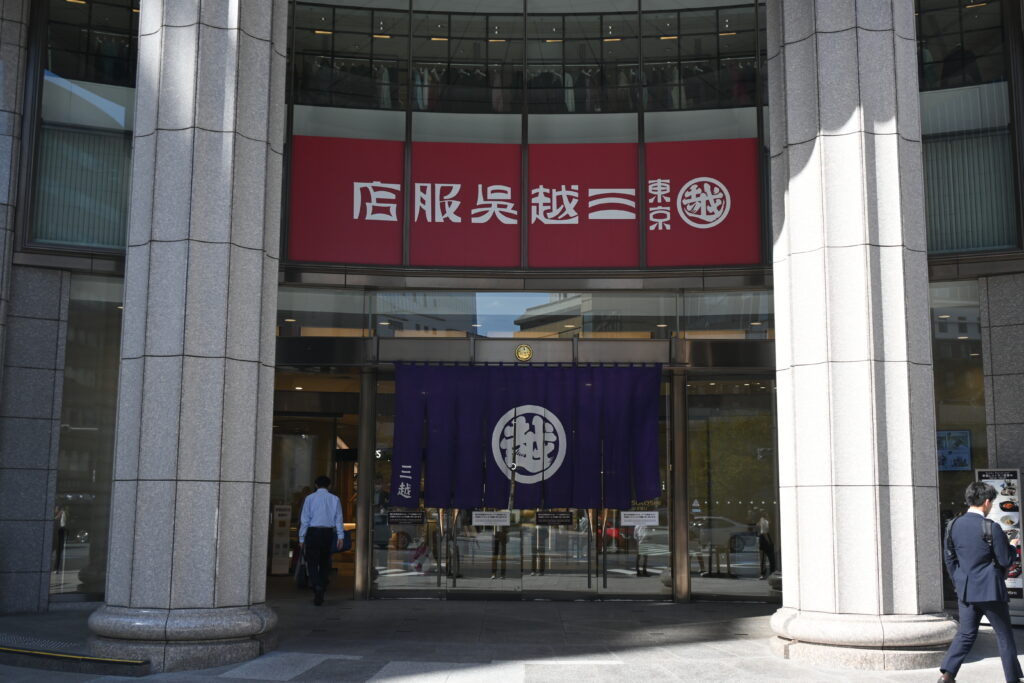
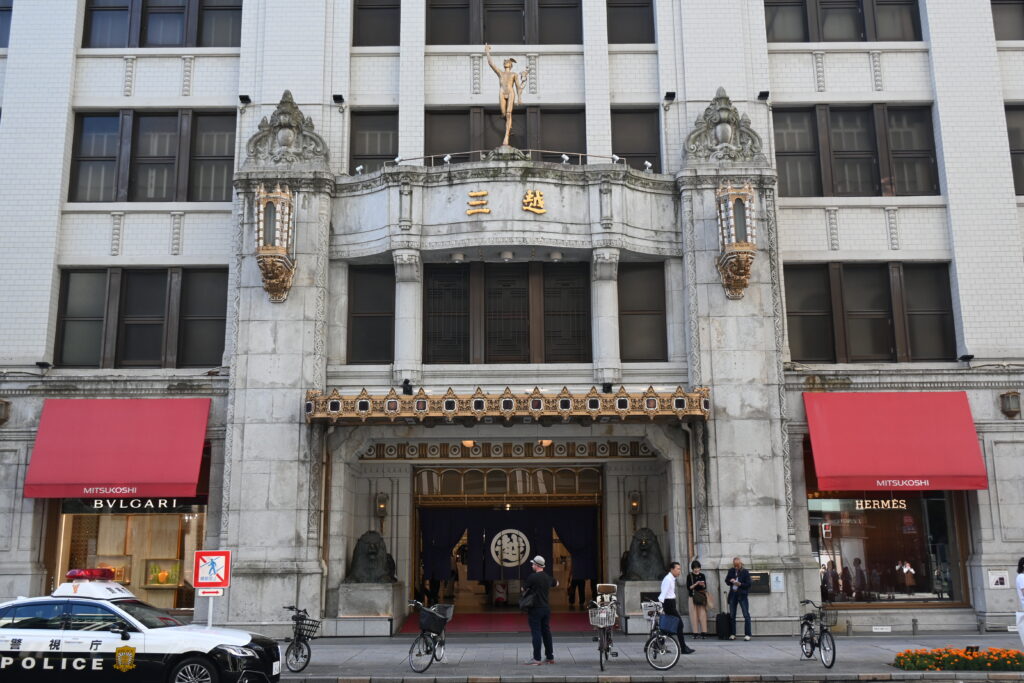
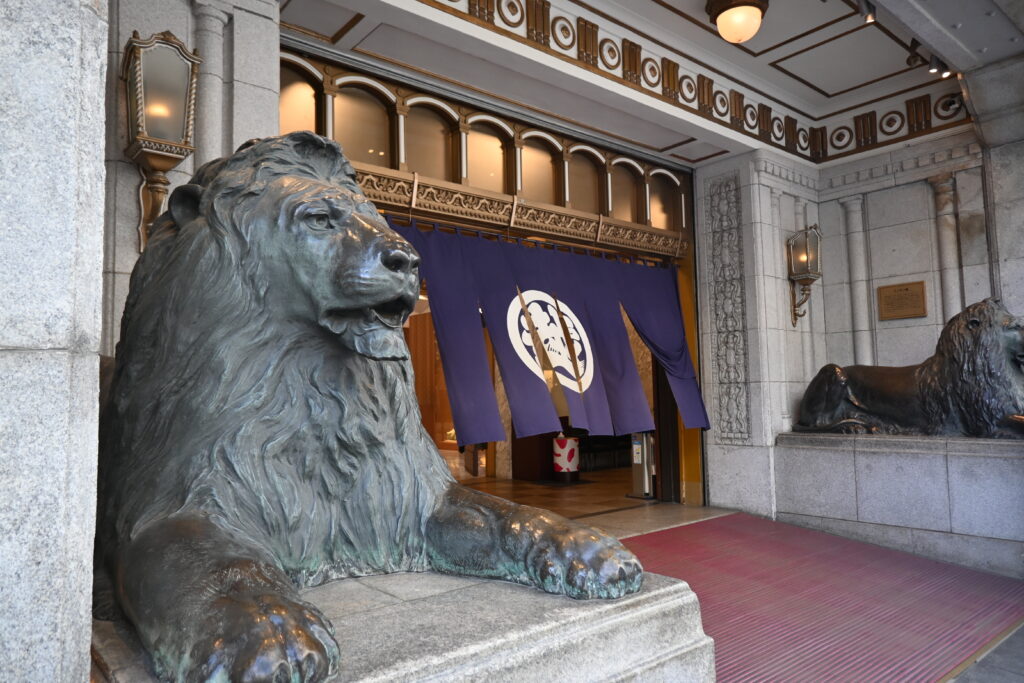
In 1904 the store declared itself Japan’s first “department store”. Two bronze lions guard the main entrance. They were made in England in 1914, modeled on the lions of Trafalgar Square in London. If you are from Europe, they may look familiar.
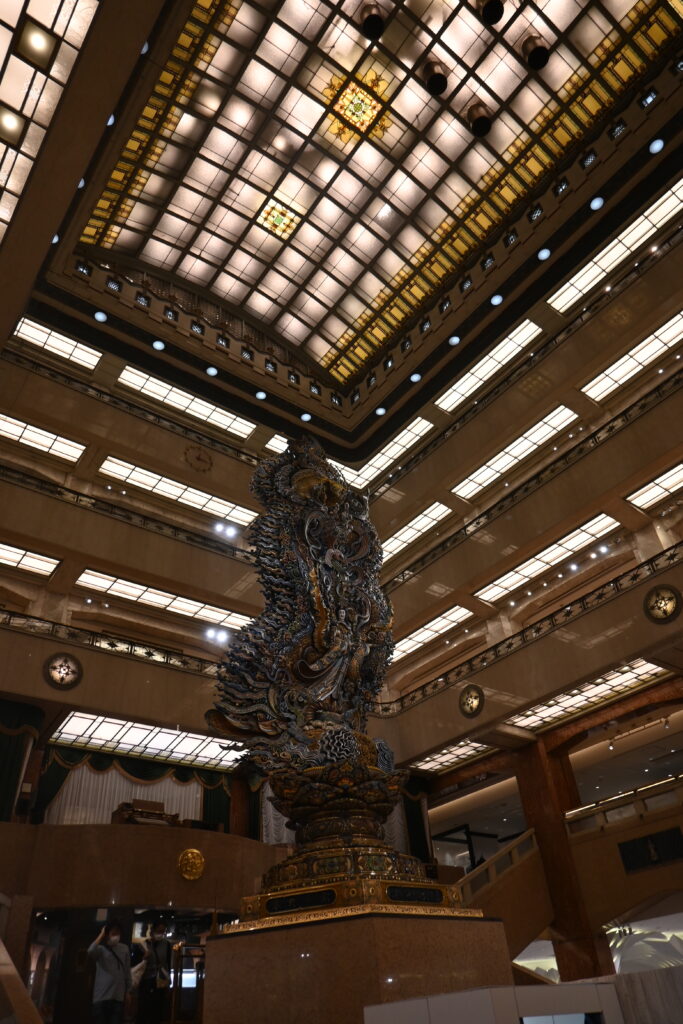
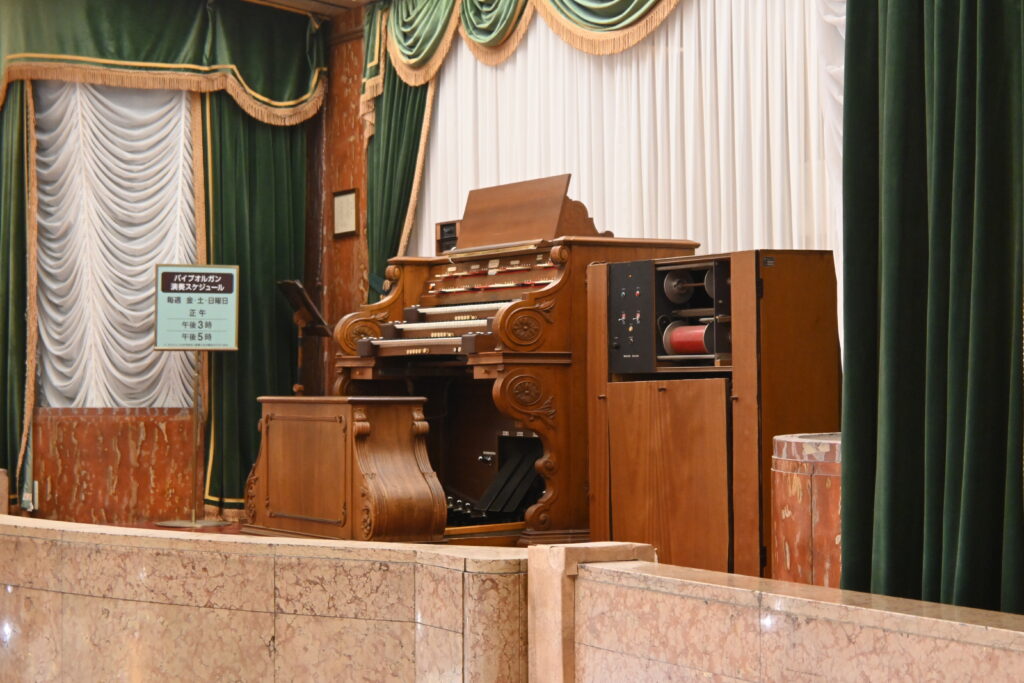
Step inside. The central hall rises five floors, and in the middle stands a carved goddess, the Magokoro (Sincerity) statue, 10.9 meters tall, made by the sculptor Sato Gengen and installed in 1960. On the balcony above is a theater pipe organ, built by Wurlitzer in the United States and installed in 1930. It is still played on certain days, so check the store’s schedule if you want to hear it.
COREDO Muromachi: old names, new buildings
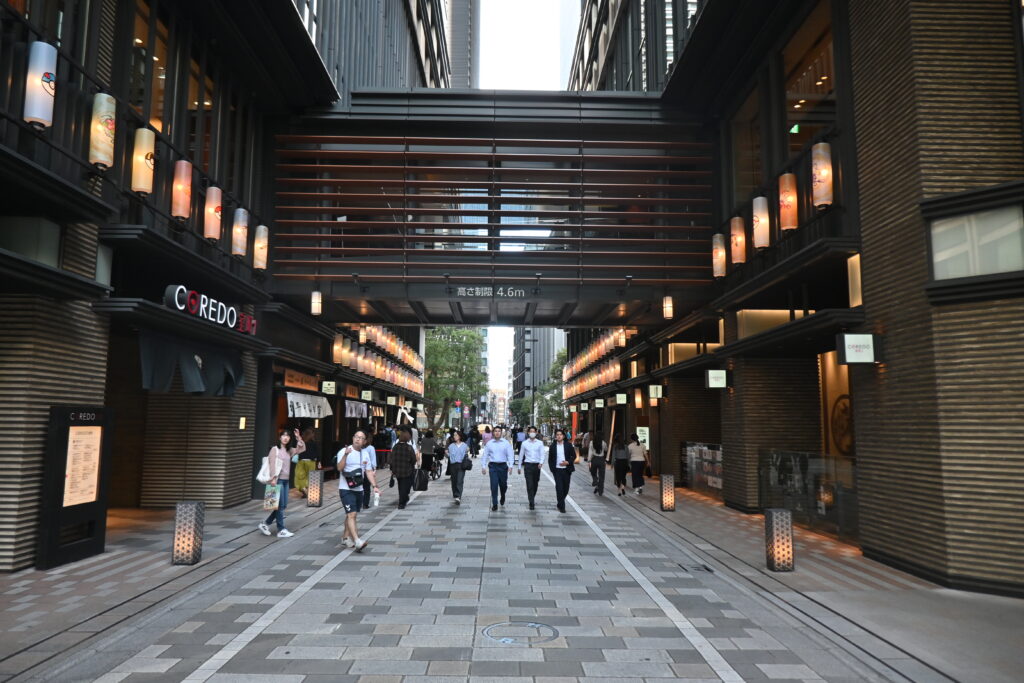
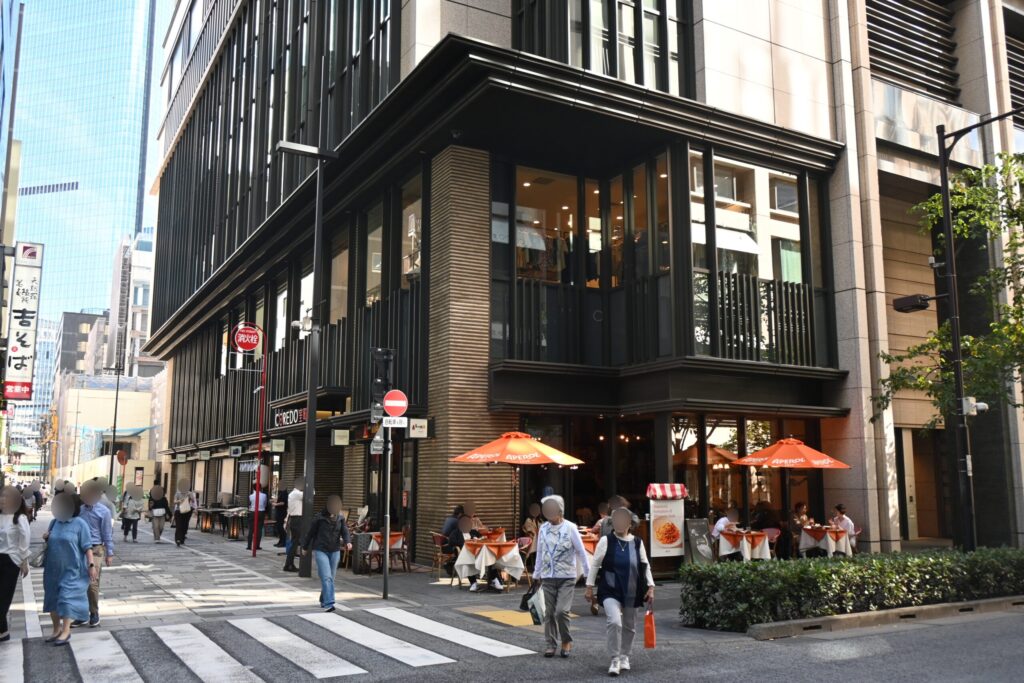
Across the street, COREDO Muromachi is a group of new buildings designed to recall the old merchant town, with dark facades, shop curtains and lanterns. Inside are small shops of long-established Nihonbashi brands: knives, dried bonito, seaweed, Japanese paper. It is a good place for gifts and for lunch.
Traveling with children? Nihonbashi is where the very first Pokémon Center opened in 1998. Today Pokémon Center Tokyo DX is on the 5th floor of the East Building of Nihonbashi Takashimaya S.C., a short walk south of the bridge (not in the main Takashimaya building).
One more Hiroshige link: the street between Mitsukoshi and the Mitsui Main Building was once Surugacho, named because it pointed straight at Mount Fuji. Hiroshige painted it with Echigoya’s shop curtains on both sides and Fuji filling the end of the street. The street plan is still the same, but today you will not see Fuji through the buildings.
The Bank of Japan, on the site of the gold mint
A few minutes west is the Bank of Japan head office, completed in 1896 and designed by Tatsuno Kingo, the architect of Tokyo Station. The site was not chosen by chance: in the Edo period this was the Kinza, where the shogunate made its gold coins.
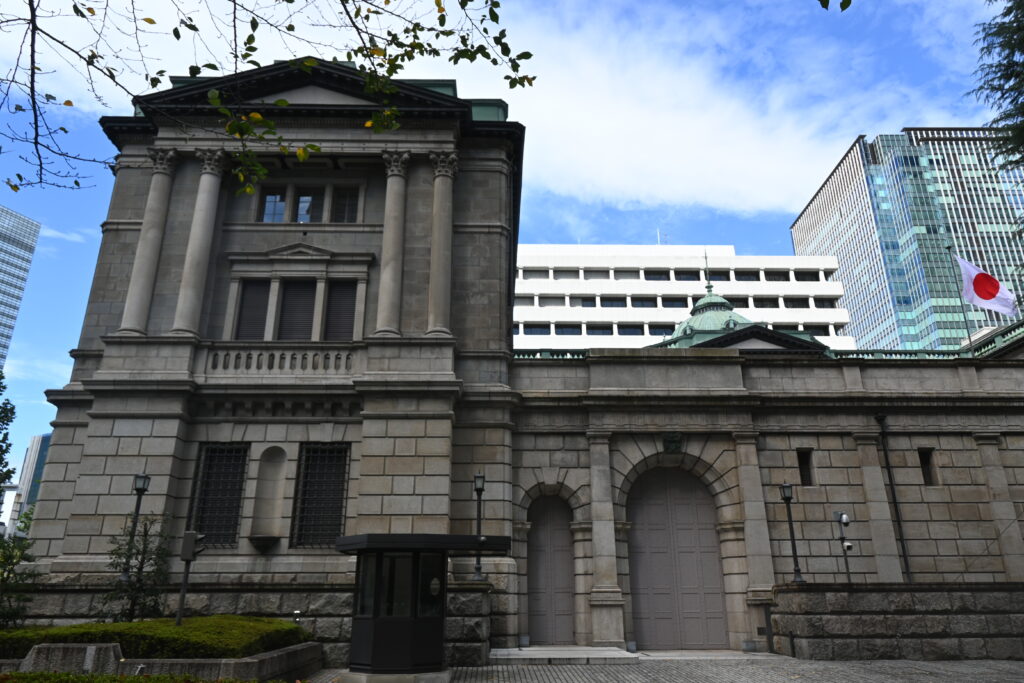
You can join a free guided tour of the building, offered in English, if you book online in advance. Across the street, the Bank of Japan Currency Museum is free and shows Japanese money from ancient coins to modern notes (closed on Mondays).
Three bridges called Tokiwabashi
Walk to the river behind the bank and you find something unusual: three bridges with the same name, Tokiwabashi, side by side.
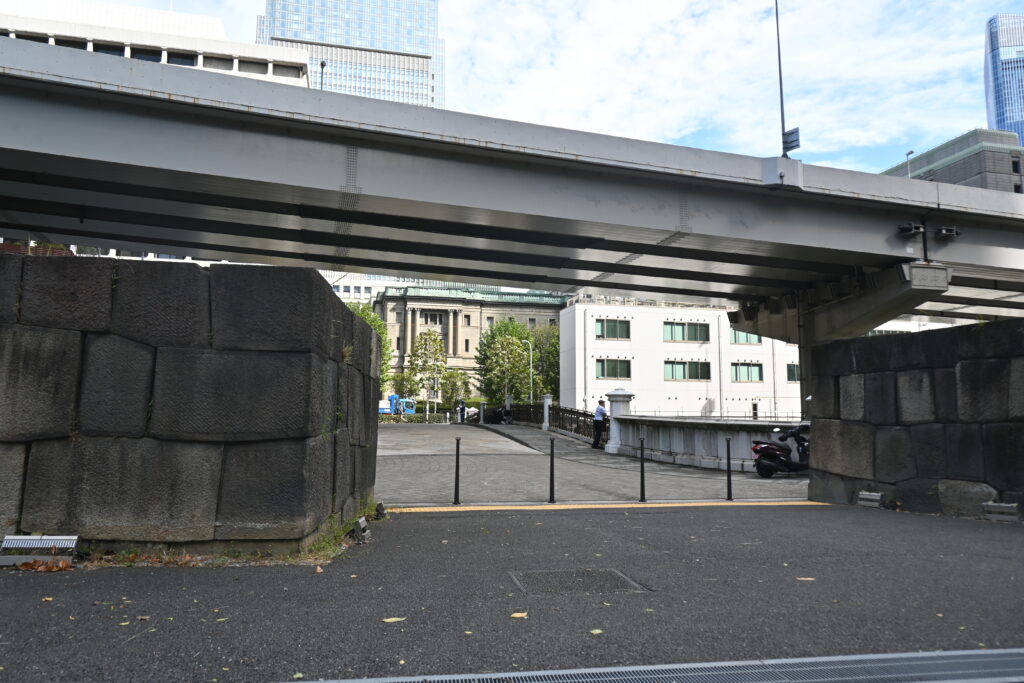
Here stood Tokiwabashi Gate, one of the main gates of Edo Castle. It was also called the Asakusa Gate, because the road from here led to Asakusa and on to northern Japan. So if you came from Asakusa today, you followed the old road into the castle. The gate was taken down in 1873, but its stone walls survive and are a national historic site.
The middle bridge is the stone Tokiwabashi of 1877, made with stones from another demolished castle gate. It is one of the oldest stone bridges in Tokyo. Downstream is a bridge from 1926, and upstream is a modern one from 1988: Meiji, Taisho and Showa, one after another.
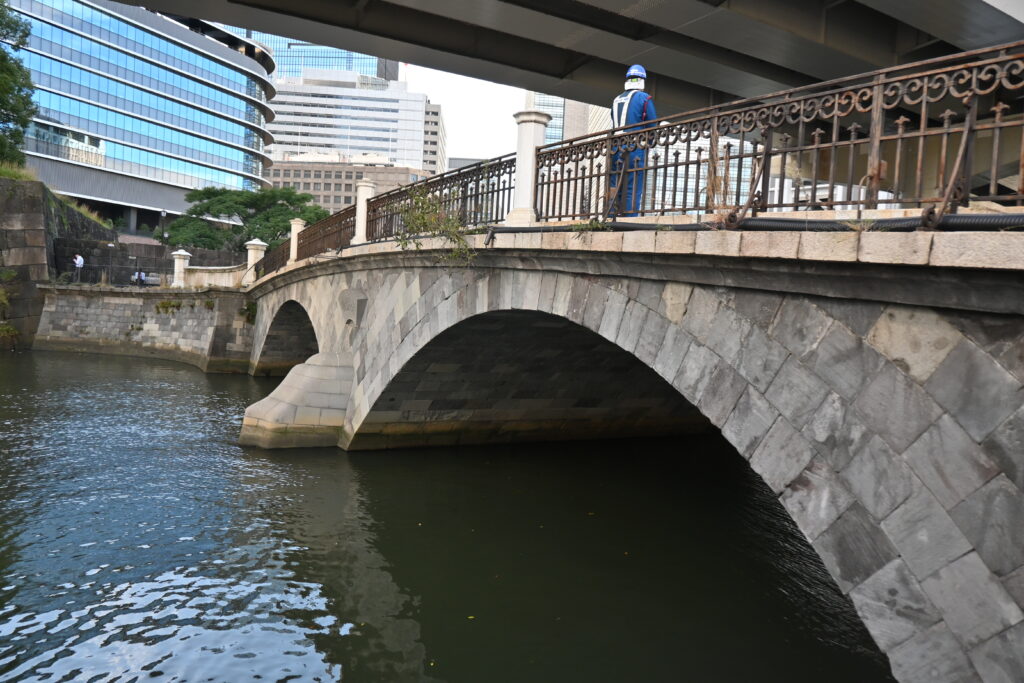
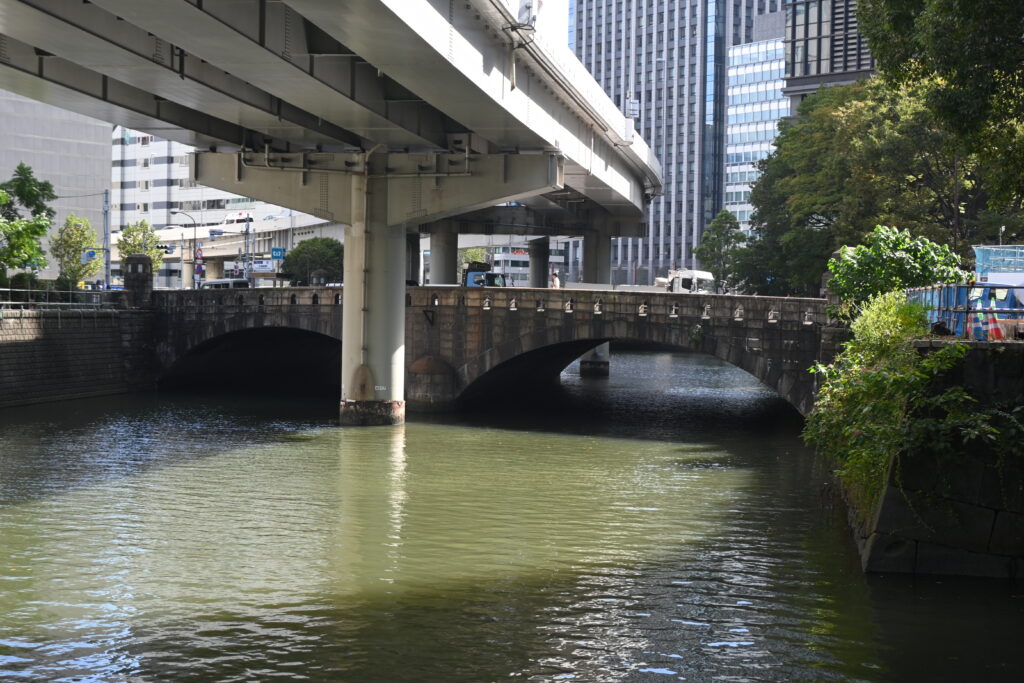
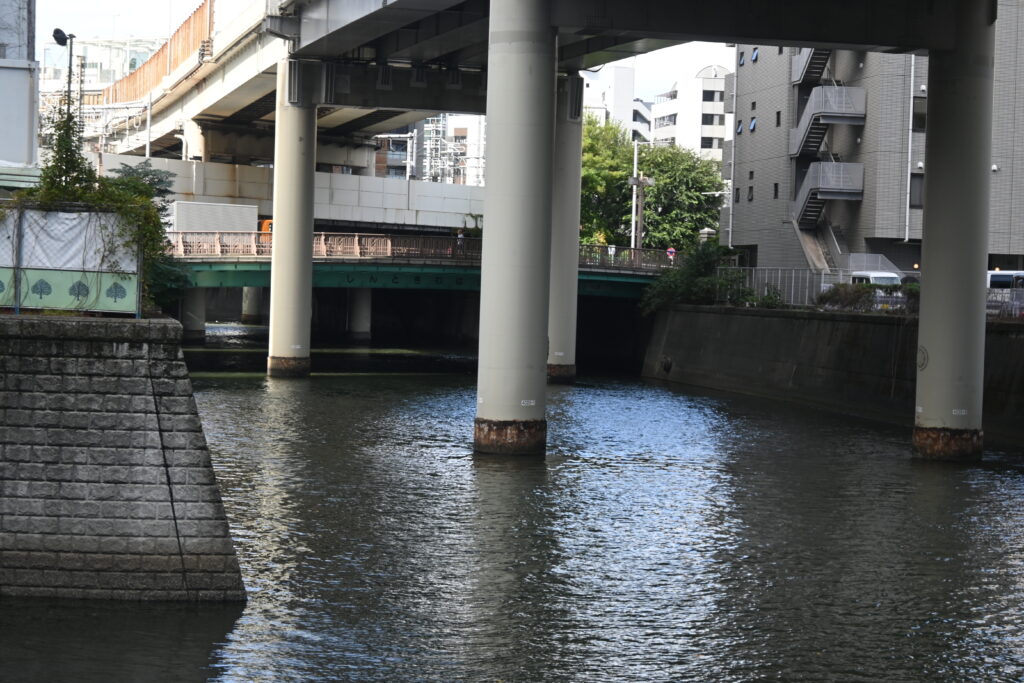
A small puzzle for kanji fans: the old stone bridge is written 常磐橋 and the 1926 bridge 常盤橋. Both are read “Tokiwabashi”. One popular story says the character 盤 (which contains “dish”) was changed to 磐 (“rock”) for the stone bridge, because a dish breaks easily. Look at the name posts and find the difference.
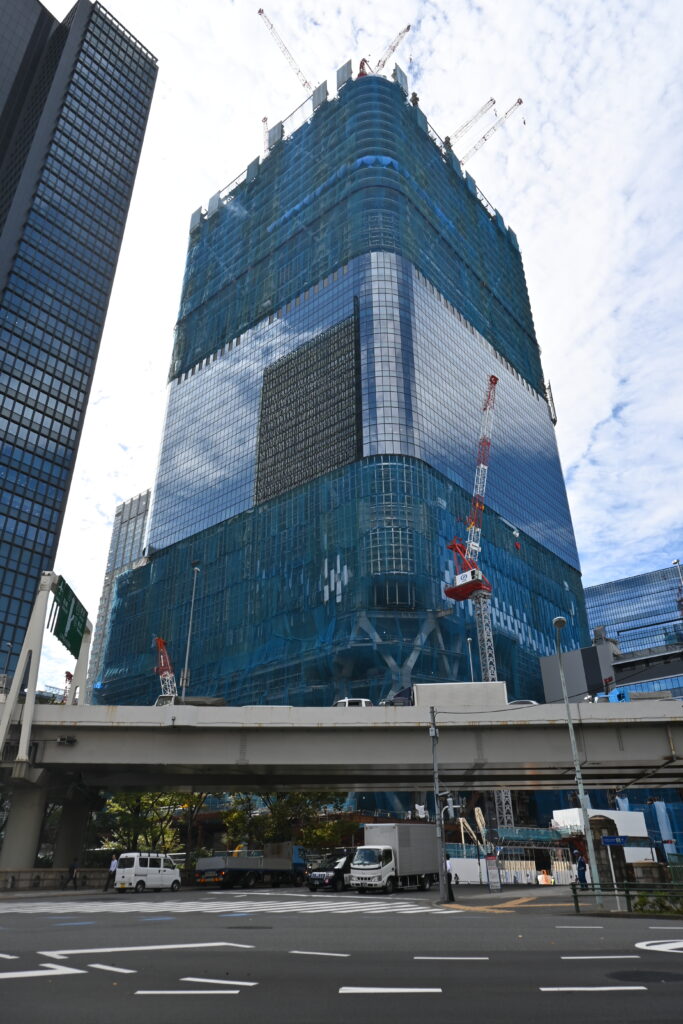
Look up from the river, too. Right next door, in a new district that also houses the city’s sewage pumping station and office, a huge skyscraper is rising: Torch Tower, about 390 meters tall and planned to be the tallest building in Japan when it is completed in the late 2020s. From the stone walls of an Edo gate to Japan’s next tallest tower, all in one view: Tokyo is still rebuilding itself.
Best time to go
Weekday mornings are calm, and the light is good on the bridge before noon. Mitsukoshi opens at 10:00. If you want to tour the Bank of Japan, book a morning slot and do the walk around it.
Good to know before you go
- It is not a pretty postcard. The expressway makes the bridge dark and noisy. That is exactly the point of this walk, but do not expect a quiet old bridge.
- Do not step into the road. The real road marker is in the traffic lanes. Even if the road looks empty, please do not cross to it for a closer look. Use the replica at the north end for photos.
- The cruise is in Japanese. You can still enjoy the views, but you will not understand the commentary.
- Plan the bank tour. The free Bank of Japan tours need an online reservation. The Currency Museum is closed on Mondays.
- Toilets. Use Mitsukoshi or COREDO Muromachi.
Getting there
- From Shimbashi: Tokyo Metro Ginza Line to Nihonbashi, about 5 minutes, ¥180.
- From Asakusa: Ginza Line directly to Mitsukoshimae or Nihonbashi, about 12 to 15 minutes, ¥180.
- From Tokyo Station: walk about 10 minutes from the Nihonbashi Exit.
Make a day of it
Continue to Edo Castle with a guide
Tokiwabashi Gate was the front door to Edo Castle, and the castle itself is only a short walk away. This two-hour walking tour with an English-speaking local guide explores the Imperial Palace grounds, the moats, gates and stone walls of Edo Castle and the story of the shoguns. It has very good reviews, many from European travelers, and free cancellation up to 24 hours before. Prices may change, so check the details and meeting point before you book.
Where to stay
Mandarin Oriental, Tokyo
Why choose: A luxury hotel high in a tower a short walk from Mitsukoshi, with views over the city. You can step out of the lobby and start this walk at once.
Mitsui Garden Hotel Nihonbashi Premier
Why choose: A comfortable mid-range hotel within walking distance of the bridge, with easy Ginza Line access to Asakusa and Ginza.
Next time
Next time, we return to the Kengo Kuma series: a walk from Omotesando to Meiji Jingu, from the streets of Aoyama to the forest of the shrine.
Photos: Aozora Walks unless otherwise noted. “Nihonbashi: Morning View” by Utagawa Hiroshige, from The Fifty-three Stations of the Tokaido: National Diet Library Digital Collections (public domain), https://dl.ndl.go.jp/pid/1309914.